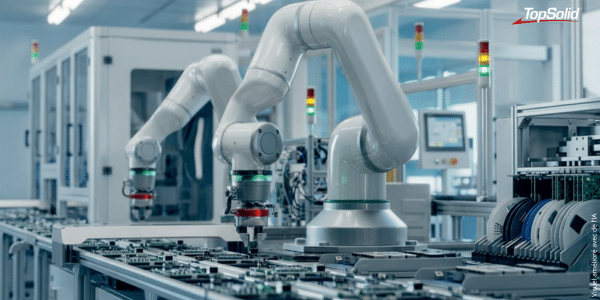
Industrial robots are becoming increasingly common in machine shops. According to the IFR’s World Robotics Report 2025, 542,000 industrial robots were installed worldwide in 2024—more than double the number from ten years ago. The question is no longer whether robots will become commonplace on the factory floor, but how to truly harness their potential.
Flexibility, reach, and the ability to work on large parts or complex geometries: these are its real strengths. But for a long time, realizing its full potential required mastering a specific programming environment that was disconnected from existing CAD/CAM tools. TopSolid’Cam Robot is a game-changer.
Launched a few years ago and set to be fully implemented in 2026, this module integrates robotics directly into the TopSolid’Cam environment, seamlessly building on the existing system, without requiring an additional learning curve, and with all the simulation capabilities that users are already familiar with. Benoît Lallier, CAM Product Manager at TOPSOLID, explains the philosophy behind it.
Why Robot Programming Is Still Holding Back Its Adoption in the Workshop
In a workshop equipped with conventional machining centers, programming is a well-established process: linear movements, X/Y/Z axes, table rotations. This is the daily routine for 95% of TOPSOLID customers. When a robot is added to this environment, the temptation is to use specialized software for it, which involves a dual expertise for the programmer, a dual database for the company, and, inevitably, disruptions in the digital chain.
Industrial robots offer complexity and flexibility, since their multi-axis kinematics are fundamentally different from those of conventional machines. But this complexity should not be passed on to the programmer. This insight has guided the development of TopSolid’Cam Robot since its launch. This is precisely what the offline programming: Design and validate a robot program from your desk, without halting production, while the cell continues to produce.
The philosophy: viewing the robot as a machine just like any other
“We’ve been developing this technology over the past few years with a clear goal in mind: to make no distinction between a robot and a conventional machine tool,” explains Benoît Lallier. “For a customer who programs parts on their machining centers, it’s intuitive.” “When it’s run on a robot, there’s no disruption. There are a few specific parameters related to the robot’s axes of rotation, but the workflow remains exactly the same.”
This philosophy shapes the entire design of the module. Rather than creating a separate tool, TOPSOLID has integrated robotics into the same framework as milling, turning, and 5-axis machining: same interface, same tool libraries, same simulation environment, same post-processor. The robot simply becomes another machine in the fleet, with its own kinematic parameters.
The impact on teams is immediate. The skills acquired during TopSolid’Cam training can be directly applied to robot programming. The only additional training required is a course dedicated to learning how to operate the robot and its work cell. Since the software automatically handles the complexity of multi-axis movements, the learning curve is greatly simplified.
Cutting tool libraries, saved methods, and standardized machining sequences: all of the company’s digital know-how can be directly reused on the robot. These are not two separate worlds; rather, there is a single programming environment, extended to a new machine.
TopSolid’Cam Robot’s Key Features in 2026
2D, 3D, and 5-axis continuous paths
TopSolid’Cam Robot generates complex toolpaths in 2D, 3D, as well as in 4 or 5 continuous axes with precision tailored to industrial requirements, regardless of the type of robot used. The part’s geometry determines the toolpath, just as it does on any conventional machine in TopSolid’Cam.
Automated Deburring and Other Robotic Applications
TopSolid’Cam Robot covers the full range of robotic machining operations: drilling, milling, contouring, and deburring, in 2D, 3D, and 4- and 5-axis continuous machining, with or without additional axes.
Deburring is one of the most immediately valuable applications of robotics in the workshop. It involves repetitive operations that are physically demanding for operators and often difficult to standardize on complex parts: this is exactly the type of task for which a robot provides clear added value.
TopSolid’Cam Robot includes automatic detection of edges to be deburred. The software identifies the relevant areas on the part and generates the corresponding toolpaths without requiring manual intervention to define each path. For companies that process series or families of parts, the time saved in programming is considerable.
Simulation and Safety
As with any machine tool in TopSolid’Cam, robot programming is based on a complete digital twin: 3D representation of the robot, its immediate surroundings, parts, and tools. Before sending any code to the robotic cell, the programmer simulates all of the movements.
Two problems specific to robotics are handled automatically. The collisions are detected early on, just like on any machining center. The singularities, these situations—where the robot temporarily loses a degree of freedom, causing unpredictable movements—are automatically identified and avoided by the software. The result: a smooth and safe process, with no surprises on the shop floor.
The post-processor
As with conventional machine tools, TOPSOLID develops and maintains certified, customizable post-processors for all robots on the market, regardless of programming language—whether ISO or proprietary.
These post-processors convert the simulated paths into a language that the robot controller can directly recognize. The programmer clicks “Send Code,” and the robot executes the commands without any corrections.
“That’s where we deliver a turnkey solution, tailored to the client’s exact needs,” explains Benoît Lallier. “The client shouldn’t have to correct anything.”
>>> See also – Technology Watch: CAD/CAM Trends That Are Redefining Industrial Competitiveness in 2026
Native integration into the TopSolid digital workflow
One of TopSolid’Cam Robot’s most significant strengths is its native integration into the TOPSOLID ecosystem. The robotic cell is not an isolated island within the company’s information system.
Robot programming data is stored in the same PDM (Product Data Management) than conventional machining programs. Parts designed in TopSolid’Design data is imported directly into robot programming—including average dimensions—for machining that meets the tightest tolerances—without any conversion or re-entry.
Product lines, tool libraries, and manufacturing files: everything is generated in the same environment and shared through the same repositories.
TopSolid’Cam Robot is primarily intended for workshops that are already equipped with industrial robots—or are planning to be—and that do not want to duplicate their programming environment.
The most common applications involve operations that require high ergonomic value or repetitive precision: automated deburring, milling of large parts, and multi-face operations on complex geometries.
The flexibility of robotic arms, combined with the programming capabilities of TopSolid’Cam, opens up possibilities that neither the robot alone nor a conventional machine tool can provide.
>>>See also – From the Design Office to the Workshop: How Can We Break Down Silos to Improve Production?
TopSolid’Cam Robot in 2026
After several years of development, TopSolid’Cam Robot reached a level of maturity in 2026 that justifies its confident adoption in production. Recent developments have notably enhanced the generation of complex continuous toolpaths, the handling of singularities, and programming ergonomics to make the experience as close as possible to that of a conventional machine tool.
Benoît Lallier sums up the goal: “Programming must be simple, fast, and reliable. There should be no difference between programming a robot and programming a machining center. That’s the challenge we’ve taken on.”
Are you already a TopSolid’Cam user and interested in exploring robotic machining? Contact our teams for a detailed discussion about your setup.