TOPSOLID Makes Its Debut in Italian High School Graduation Exam Rooms
From CAD/CAM design to CNC tooling: how the second year of the new “Mechanical Manufacturing for Made in Italy” program turns a high school diploma into a true springboard to local businesses.
Imagine an exam in which you are not only asked to recite a formula by heart, but also to act like a production engineer at a mechanical engineering company.
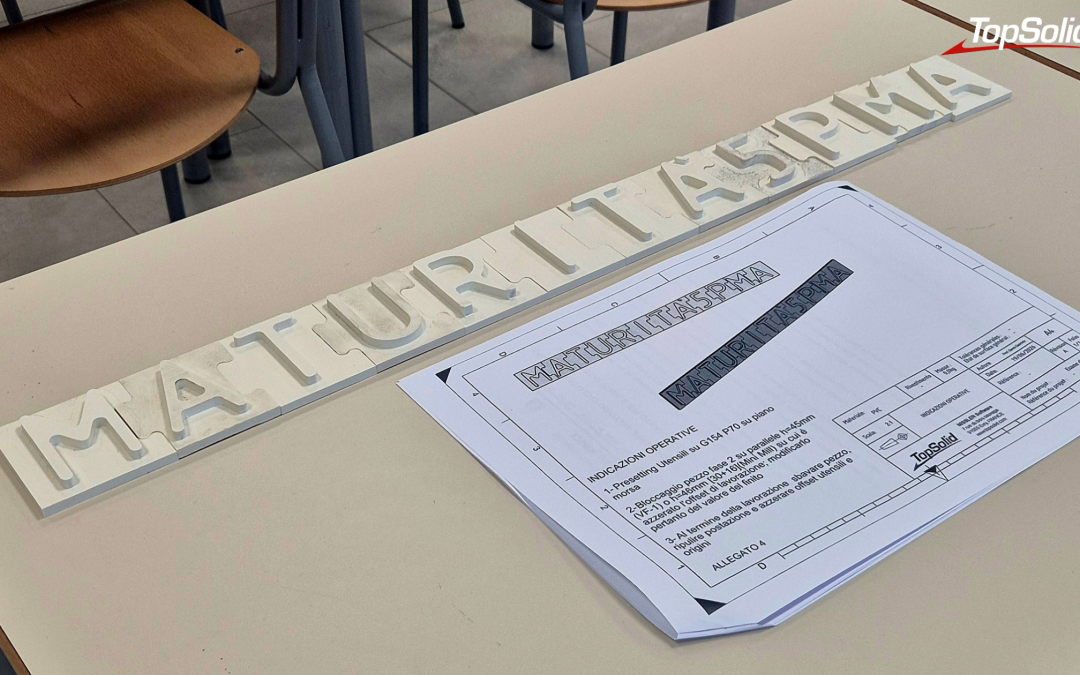
Calculate the stresses in a C43 steel shaft, select bearings from the manual, design a gearbox housing using CAD, define the CAM strategy, and, finally, go to the workshop to set up the part and adjust a CNC machine.
This is not a description of a workplace integration program, but rather the actual topic of the second section of the state exam for the IP13 track—Industry and Crafts for “Made in Italy” (mechanical manufacturing).
A perfect bridge between the classroom and the Industry 4.0 workshop, which the students crossed by using a comprehensive software suite such as TopSolid.
We interviewed Professor Gabriele Gerini, a lab instructor at the I.I.S. Leonardo da Vinci in Florence, Italy, who guided the students through an experimental project that proved to be successful.
Professor, this year the students took an exam that focused specifically on “Made in Italy” and the local region. What was the exam committee’s objective?
“For our school, this academic year marks the second and final year of the new program, “Mechanical Manufacturing for Made in Italy.” Compared to last year, we have sought to give the exam a more specialized and technical focus; as stipulated by the ministerial decree, the exam is developed by the examination board within a general framework in order to highlight the school’s unique characteristics and the actual training experiences undertaken by the students.”
What skills are actually assessed in an exam of this type?
“An exam structured in this way combines various skills. Students must demonstrate that they have acquired skills in the areas of design, three-dimensional technical drawing, and CAM programming, as well as in the setup and commissioning of CNC machines. I believe that such a well-rounded profile—capable of managing all phases of the product lifecycle—is highly sought after by companies, which today are specifically looking for versatility and competence.”
In your opinion, in the field of mechanical engineering, how important is it to combine CAD/CAM design with mechanical sizing, as opposed to relying solely on theory?
“Successfully giving form to what students study, conceive, and design is fundamental to fostering a more critical and truly enlightened education. In fact, I find that Confucius’s words are more relevant than ever: “If I listen, I forget; if I watch, I remember; if I do, I learn.” Theory is fundamental, but it only acquires value when it becomes a tool for solving a real-world production problem.”
How did the students react when they discovered an exam question so closely related to a real-world industrial case?
“Rather than surprise, I would describe it as a positive realization on the part of the students. Since this was an exam designed by the jury based on ministerial guidelines, the students knew they would be faced with a real-world, challenging scenario, but they had absolutely no idea what the specific content would be. Their composure stemmed from their experience over the past two years—and particularly this past school year—during which we worked extensively on developing concrete projects. By getting them accustomed on a daily basis to transitioning from theoretical and technical study to practical application, they arrived on exam day equipped with the intellectual and operational tools needed to tackle the subject with great maturity.”
>>> See also – TopSolid Education and Industrial Training
What were the most common challenges students faced during their training?
“The students were exposed to a large number of practical cases and a wide variety of technologies. This exam focused specifically on milling, but throughout the year, students completed projects involving turning, laser cutting, and 3D printing, with the goal of integrating all the technologies available at our school into complex projects, while also performing geometric and dimensional measurements and inspections using a coordinate measuring machine (CMM). During their training, they experimented with different programming strategies, the selection of cutting parameters, and machining settings, emphasizing approaches specific to different materials, while keeping an eye on production deadlines and tool sharpening times. The machining operations performed were primarily 2.5-axis, in some cases 4- to 5-axis positioned, with a notable example of continuous 5-axis machining.”
On average, how long does it take for a student to become proficient in using TOPSOLID?
“With an appropriate learning method and consistent motivation to design and produce a variety of mechanical parts, I believe that one school year can be enough to bring students to a level of autonomy that is more than sufficient. In fact, this was confirmed during this first experimental year, when we chose to use TopSolid for the high school graduation exam. Of course, when it comes to more complex machining operations, shapes, or specialized materials, the time required increases; however, I believe the biggest obstacle lies in understanding the underlying logic of the software, which, based on my experience and student feedback, is actually very intuitive.”
What skills distinguish an average student from one who is particularly well-prepared?
“I’m pleased to see that all the students who were trained in the software demonstrated sufficient skill to program a relatively complex mechanical part from scratch, such as the one specified in the exam. For someone in my line of work, that’s the greatest satisfaction: being able to involve everyone without leaving anyone behind.”
“Of course, I am also proud of the exceptional performance our young people have demonstrated, which I am convinced will lead them to rewarding careers. The difference lies in the informed choice of the right machining steps and in the optimal determination of cutting parameters, taking into account machining lead times and the actual availability of tools in the shop. A young person who can integrate all this information and translate it into smooth, efficient programming is undoubtedly ready to take on the challenges of an industry constantly seeking skills at this level.”
When analyzing the topic, we move from calculating stresses (bending and shear) to the CAM machining strategy and tooling. At what stage did the students demonstrate the greatest technical maturity?
“Overall, the students proved themselves at every stage. CAM programming was certainly the biggest hurdle, but they all overcame it with flying colors, and some particularly brilliant students even accomplished this task remarkably well. The most complex part remains the calculation and sizing: let’s not forget that this is a vocational school, which enrolls students with a practical and hands-on focus; having them take such a comprehensive exam was a challenge we wanted to set for them, and they rose to it brilliantly. The stage that pleasantly surprised me the most was the machine setup. All students completed the practical portion entirely on their own, performing the fundamental operations of tool presetting, workpiece zeroing, and program management. Some even made judicious choices when adjusting the compensation radius to meet design tolerances. Completing such a task as part of an exam has a significant impact on anxiety management and performance: an aspect that, as examiners and faculty, we can only commend and value.”
Preparing a class for such a comprehensive exam requires significant teamwork among teachers and a well-structured curriculum. What advice would you give to your colleagues at other schools who would like to implement similarly integrated CAD/CAM programs?
“The planning for this school year was intense, thoughtful, and engaging. The complete integration of hands-on projects with the core subject (Design and Production) created a synergy that allowed each activity to be structured from start to finish, from design to completion. The effort required to set up materials and prepare lessons—all while meeting the deadlines imposed by increasingly tight schedules—is far from simple. But when approached with enthusiasm, it enables us to achieve any goal with the students, rediscovering in them that passion which still makes us believe that school is the place where a person’s character is forged and where dreams and ambitions are built.”
All of this was made possible thanks to the entire TOPSOLID team—from administrative and sales managers to technicians—who never failed to support us. The path ahead is exciting, and as an institution and a mechanical engineering department, we look forward to following it and implementing it more and more alongside future generations of students.
Before concluding, we would like to thank the I.I.S. Leonardo da Vinci in Florence and Professor Gabriele Gerini for sharing this innovative educational experience, which offers a concrete glimpse into how schools can meet the needs of modern industry and prepare young people for the challenges of the future.
Special thanks also go to Benso Tuscany Srl, a TopSolid reseller, and specifically to Gianpiero Sigismondi, whose personal commitment and great dedication made it possible to design, support, and bring this important training project to life. This valuable collaboration has paved the way for a positive future for the school and the local community.
The school’s experience shows that CAD/CAM is no longer just a tool used in the workplace, but can become a central component of education—even at the high school level. Introducing TopSolid into the classroom meant asking students to think like technicians, designers, and production operators, applying real-world skills that are immediately applicable in the workplace.
It has been confirmed that when schools, technology, and pedagogy work in harmony, the line between education and the professional world blurs to the point of nearly disappearing. Thanks to the program they’ve completed with TopSolid, these young people don’t enter the industrial world as beginners: they’ve already acquired the methodology, basic independence, and technical vocabulary needed to quickly integrate into a company and begin their true professional development journey.
And, in an industry constantly seeking skilled workers, this may be the most important outcome of all.