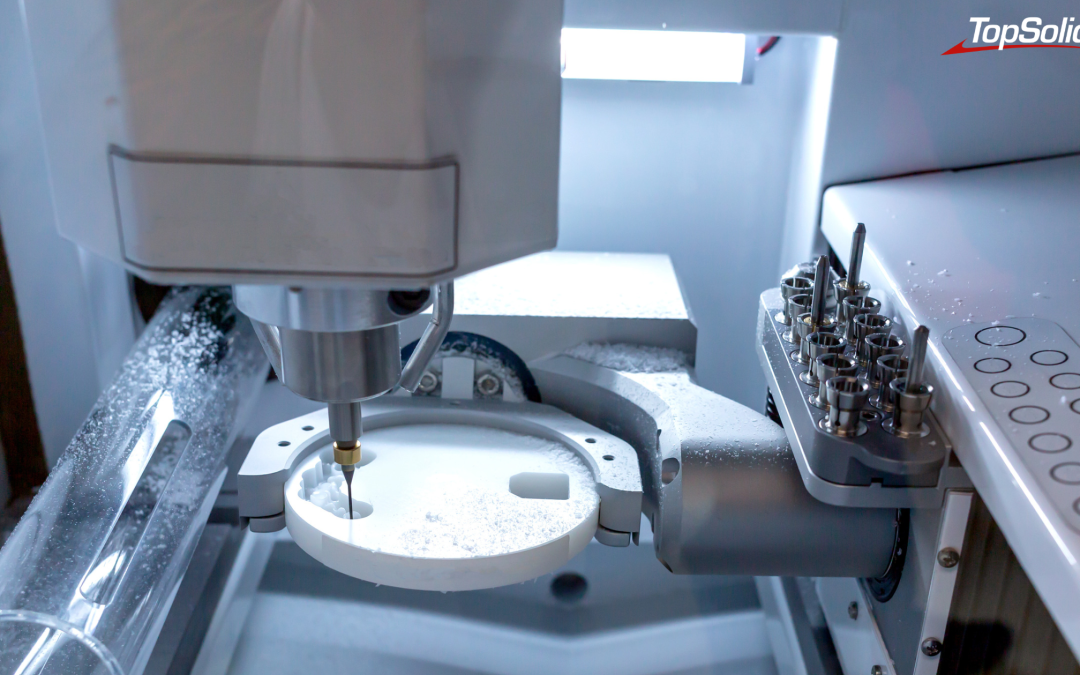
Medical machining refers to the manufacture, through material removal, of prostheses, implants, instruments, and components for medical devices. CAD/CAM software plays a unique role in this field: its use must be validated prior to implementation within an ISO 13485 quality management system, and it must allow users to determine, years later, which program version was used to machine a specific part. Here’s how to translate these requirements into selection criteria.
What the Medical Industry Requires of Design and Manufacturing
A regulatory framework that requires everything to be retained
Since May 26, 2021, Regulation (EU) 2017/745 has governed the placing on the market of medical devices. The manufacturer must keep the technical documentation available to the authorities for at least ten years after the last device in question is placed on the market, and for fifteen years in the case of an implantable device. The regulation also establishes a unique device identifier (UDI), which is registered in the European Eudamed database.
A precision machining subcontractor is not considered a manufacturer under the regulations. Nevertheless, its customers provide it with a significant portion of these requirements: drawing numbers, material certificates, and inspection records.
A standard that also applies to your software
ISO 13485:2016 certification is not required by law, but clients in the industry very often require it. The 2016 revision requires that software used in the quality system, in production, and for measurement be validated (paragraphs 4.1.6, 7.5.6, and 7.6): before initial use, and then after each modification, with an effort commensurate with the risk. The LNE also offers a training course on this requirement.
One point deserves clarification, as it is often a source of confusion: validation focuses on how you use the software within your organization. The standard governs a company’s quality system, so there is no such thing as “ISO 13485-certified” CAD/CAM software. It is your responsibility to describe the intended use of the tool, assess the risk that its failures would pose to the part, test the corresponding scenarios, and maintain records. The ISO/TR 80002-2 guide details this process.
CAD/CAM software that generates machine programs falls within this scope. Choosing it also means choosing what you’ll have to validate—and then revalidate.
Demanding Parts, from Single Units to High-Volume Production
The medical field ranges from implants machined for a single patient to components produced by the thousands. The geometries are complex, the materials are expensive, and 5-axis machining centers—such as MillTurn machines—are now commonplace in these workshops.
Six Criteria for Choosing CAD/CAM Software Suitable for Medical Machining
1. Associative CAD and CAM
A customer modifies a tolerance. If the CAM system runs separately, the data must be reimported, reprogrammed, and rechecked—with a real risk of machining the old dimension. In the TopSolid’Cam CAM software, CAD and CAM are parametric and associative: the machining plan updates automatically as the model changes, and part revisions are managed through the PDM.
Demonstration: Change a dimension on a part that has already been programmed and see what updates automatically.
2. An integrated PDM system that maintains a 15-year history
Fifteen years spans several generations of workstations, software versions, and employees. A shared file server is not designed to last that long. The right solution is a PDM system integrated into the design and manufacturing environment, which tracks versions of each document and records who approved what.
This is the approach taken by VERMON, which designs and manufactures ultrasonic probes in Tours, primarily for use in ultrasound imaging. The company chose TopSolid, among other reasons, for its integrated PDM, which now manages tens of thousands of models.
“PDM is now a cornerstone of our design work.”
Christophe Notard, Program Management Officer at VERMON
>>> Lire aussi –Sous-traitance multi-clients : l’épineuse question de la traçabilité
3. Programming and simulation that match the complexity of the parts
Une pièce rebutée dans un alliage de titane se paie en matière autant qu’en temps machine. Le logiciel doit couvrir tous les procédés d’usinage CNCde l’atelier et simuler la machine réelle.
- Processes: TopSolid’Cam handles 2D to 5-axis milling—both positional and continuous—as well as turning and bar turning.
- Customer Data: It reads STEP, IGES, Parasolid, and the native formats of major CAD tools, and imports tolerances and surface finishes (PMI).
- Simulation: Three levels, up to ISO code simulation using the shop floor machine’s macros, including collision detection.
4. Quality control tied to the drawing and the part
TopSolid’Inspection starts with the drawing: dimensions are automatically extracted using optical character recognition, and then measurements are entered on a tablet or imported from a coordinate measuring machine. The software manages serial numbers, tracks inspectors and instruments, calculates Cp and Cpk values, and generates customizable FAI reports.
5. Lot-by-lot traceability in production management
A batch of material is under investigation. How long will it take to list the parts manufactured with it and the customers to whom they were delivered? TopSolid’Erp, which is designed specifically for the medical industry, ensures the traceability of batches, serial numbers, and material certificates across purchasing, inventory, production, and sales. Its quality module covers FAI, nonconformities, corrective actions, and exceptions.
TopSolid’Erp, which is designed specifically for the medical industry, ensures the traceability of lots and serial numbers across purchasing, inventory, production, and sales. The material certificate is linked to the corresponding receipt, and its data serves as search criteria: certificate number, casting number, and material lot number. Its quality module covers FAI, nonconformities, corrective actions, and exceptions.
6. An editor that makes validation and updates easier
Every update requires revalidation. Before signing, ask whether release dates are published in advance (TopSolid publishes a TopSolid’Update calendar), whether the changes are detailed enough to guide your testing, and who will train your teams. Also keep in mind that every piece of software added to the workflow is one more piece of software to validate: a suite that shares the same data limits the number of interfaces that need to be qualified.
Quality, Compliance, Productivity: What’s Changing on a Daily Basis
In terms of quality, the part is machined to the approved specification, since the program remains linked to the versioned model.
In terms of compliance, an auditor who selects a serial number can trace it back to the plan index, the program used, the material lot, and the inspection report with a simple query, without having to piece together the information from emails.
In terms of productivity, TopSolid’Cam lets you save operations as favorites, copy a machining sequence from one part to another, and apply machining sequence macros: proven strategies can be reused on similar parts.
Compliance remains the responsibility of the quality system: the software provides the evidence, and the organization uses it. To learn more, discover our CAD/CAM machining software for the medical industry.
| Do you machine parts for the medical industry? Our experts analyze your production process—from the customer’s design to the inspection report—and identify gaps in traceability. Contact us or request a demonstration. |
Frequently Asked Questions About Medical Machining
Is ISO 13485 certification mandatory?
No, the ISO standard specifies that certification is not a requirement of the standard. However, medical device manufacturers very often require this certification from their suppliers.
What is medical machining?
This involves the fabrication—through material removal, most often using CNC machines—of parts for the healthcare sector: prosthetics, implants, surgical instruments, and device components. It combines high precision with traceability requirements mandated by medical device regulations.
Is it necessary to validate CAD/CAM software in accordance with ISO 13485?
Yes, as long as it is used for production, and the responsibility for this validation lies with the company using it. This involves demonstrating that the tool fulfills the purpose for which you are using it: described intended use, assessed risks, tested scenarios, and retained records. This must be done before the first use and after each modification, with an effort commensurate with the risk to the product. IEC 62304 does not apply here: it applies to software that is itself a medical device or forms part of one.
How long should documentation for a medical device be retained?
At least ten years after the last device in question was placed on the market, and at least fifteen years for an implantable device, in accordance with Regulation (EU) 2017/745.