
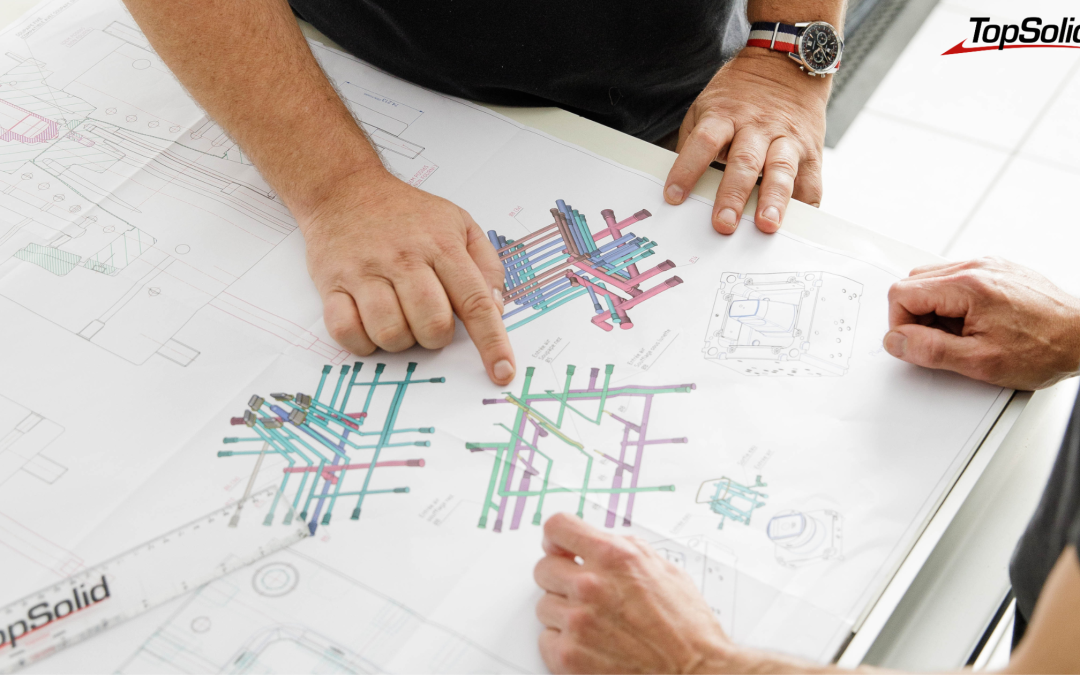
Photo credits: Simon (39), a specialist in the manufacture of plastic injection molds and high-precision machining, Stéphane Couchet©
Design-to-cost is a design method that incorporates cost constraints from the earliest stages of a project to guide technical decisions toward the most cost-effective solutions without compromising the part’s intended function.
Its rationale can be summed up in one sentence: a significant portion of manufacturing costs is incurred in the design office, long before the first chip is cut. The question remains: how to apply this in practice—methods, variables to monitor, and cost-estimation tools such as TopSolid’PartCosting to convert geometry into cost estimates before the design is finalized.
The cost of a part is largely set before production begins
In many companies, manufacturing costs are treated as an afterthought. First, a product is designed; then, a cost estimate is prepared; then, production begins; and finally, the variance is identified. This is a backward approach.
Yet the decisions made in the design office account for the bulk of the final cost. A tolerance tightened by one hundredth, a fillet radius too small for standard tooling, a material that is difficult to machine: each of these factors translates into machine hours, specialized tools, and additional rework or inspection steps. None of them costs anything at the time they are made. All of them take their toll during production.
That’s the paradox: it is precisely when we have the least information about the cost that we have the most leeway to influence it. Once the plan has been approved and the order signed, there is no longer any room to maneuver. All that remains is to make minor optimizations or absorb the shortfall.
The current environment makes this process more challenging than before. Margins are under pressure, raw material prices fluctuate from quarter to quarter, and clients expect a detailed quote within a few days. Noticing the discrepancy after the fact is no longer a viable option.
The 5 design variables that affect cost
Not all design decisions carry the same economic weight. Five categories account for the bulk of the impact:
- Geometric complexity. Shapes, surface accessibility, and the number of machine-assisted adjustments and repositioning operations.
- Processing time. A direct result of the geometry, the applicable cutting conditions, and the tools available in the workshop.
- Material consumption. Selected rough shape, chip volume, scrap, and sensitivity to material price.
- Manufacturing processes. Machining, sheet metal fabrication, metal fabrication, bar turning, surface treatments, and subcontracted operations.
- Inspection and rectification procedures. Dimensional requirements, deburring, surface finishes, quality documentation.
These variables interact with one another, and that is what makes the trade-off difficult. Making a part lighter can increase machining time. Simplifying a geometry may require a larger blank. Without a calculation tool, the decision relies on the designer’s knowledge of manufacturing processes and intuition… and intuition, when it comes to cost, is rarely reliable.
What a “design-to-cost” approach actually changes
The approach is not about designing poorly in order to design more cheaply. It is about making cost visible at the moment a decision is made, just as one would consider mechanical strength or size. The designer is no longer at the mercy of cost estimates; instead, he or she incorporates them as just one design criterion among others.
Three things change as a result. The engineering department compares alternatives based on hard numbers rather than gut feelings. The sales department has a well-structured price that it can defend to a client. And the shop floor receives specifications whose assumptions match its actual conditions—its machines, its tools, and its cutting conditions.
Expected benefits, in order of priority:
- Manufacturing costs are kept under control because costly trade-offs are identified before they are set in stone in a plan.
- A smaller discrepancy between the estimate and actual production, with time calculations based on shop floor parameters rather than on estimates based on experience.
- Optimized design choices, based on a comparison of several technical options in terms of their actual cost.
- Improved profitability by limiting the number of deals accepted at a loss and concessions granted blindly.
- Faster and more reliable decisions on bids where the response time has become a selection criterion.
This last point deserves some clarification. Responding quickly is pointless if the answer is wrong. The real benefit isn’t speed alone—it’s speed with reliability.
How to Implement a Design-to-Cost Approach: Four Steps
Moving from intention to action requires a method. Here is the sequence that underlies most successful approaches in mechanics.
1. Set a cost target before you start drawing
This is the step that distinguishes “design to cost” from simple optimization. The target is derived from the acceptable market price and the target margin, not from the cost of the previous generation. The design team must know this target when it begins the design process; it should not be communicated only after the project review. Without a quantified target established early on, the process is reduced to seeking cost savings on a design that has already been finalized.
2. Identify the cost drivers specific to your parts
The five variables described above do not carry the same weight in every situation. In bar turning, cycle time and hidden times are the dominant factors. In sheet metal fabrication, it is the material size and weld length. In precision machining, it is often the tolerances and inspection operations. Start by analyzing your past projects to identify where the gap between the estimate and the actual cost is actually widening: that’s where your drivers lie.
3. Provide a cost estimate for each option, not just the selected solution
A “design-to-cost” approach is only valuable if it yields a comparison. Designing two or three variants and calculating their costs makes it possible to objectively evaluate a decision that would otherwise be based on intuition. The practical consideration is the computation time: If it takes half a day to estimate a variant, no one will do it within a project’s deadline. It needs to be reduced to just a few minutes for the comparison to become standard practice.
4. Capitalize on data from your workshop
A calculation based on theoretical standards yields a theoretical cost. Cutting conditions, setup times, and the actual production rates of your machines must be entered into the calculation databases, and these databases must be shared by everyone involved in cost estimation. This is what makes the consistent results from one piece to the next and independent of the experience of the person using the tool. This is also what ensures that the process continues even after the most seasoned estimator leaves.
These four steps require one final prerequisite—an organizational one: that the engineering department, the estimating department, and the shop floor all share the same cost assumptions. A “design-to-cost” approach led by a single department rarely yields sustainable results.
Supporting the process: Costing the part from the very first iterations
A “design-to-cost” approach without a calculation tool remains merely an intention. We need to be able to convert a geometric model into a cost estimate quickly, and repeat the process for each variant.
TopSolid’PartCosting meets this need for mechanical trades: machining, sheet metal work, metal fabrication, and bar turning. The calculation is based directly on the part drawing, in 2D or 3D (PDF, scan, image, DXF, DWG, STEP, or IGES), and can still be performed even without a drawing.
There are several methods available, depending on the level of precision required: part analogy, chip volume, detailed cost estimate, and multi-spindle simulation. All of them rely on libraries configured for the company’s actual environment and shared among all the dividers. This is what makes the result comparable from one part to another and independent of the experience of the person performing the calculations. The manufacturing processes are built into the tool: even a designer who does not fully grasp all the nuances still has a solid basis for calculation, whereas previously they had to rely on their intuition.
In practical terms, as soon as a geometry exists, it can be costed. This is where the time savings come into play: the first design iteration is fully costed, and subsequent variants are evaluated by part analogy, much more quickly. Comparison becomes a routine operation, not a project in itself. Two design variants are compared based on their cost centers (manufacturing, setup, scheduling, subcontracting, tooling, supplies), including management of non-recurring costs and quantity variations: tooling, setup, subcontracting, and supplies.
The tool can be used standalone or integrated with your MPS/ERP system, via a gateway to your existing solution. The integration is more extensive with TopSolid’Erp: The cost estimate is then fed directly into the production management system, eliminating the need for re-entry and ensuring a seamless transition between the quote and manufacturing.
>>> See also – ERP Software for Industrial Workshops: How to Centralize Production, Planning, and Maintenance?
To anticipate, or to observe
Faced with tight margins and volatile raw material prices, there are two possible approaches. You can identify the discrepancy after the fact, on a case-by-case basis. Or you can make it clear before committing.
The challenge of design-to-cost is to take manufacturing costs into account from the design stage onward. The goal of the technical estimate is different, yet just as crucial: to come as close as possible to the actual cost in order to win a profitable contract.
This second issue primarily concerns subcontractors. A client who designs its own parts seeks to control the cost. A subcontractor, on the other hand, receives a drawing that it did not create and must determine a price based on it—without overestimating, at the risk of losing the contract, or underestimating, at the risk of winning it at a loss.
Accurate pricing, therefore, means being able to defend your price to a client without giving in during every negotiation.
In both cases, the approach involves equipping the design office and the estimating department. This is essential to ensure that costs no longer come as a surprise at the end of a project. The first approach is convenient: it doesn’t change anything about current practices. The second approach involves equipping the engineering department and the estimating team. It is also the only one that allows you to defend a price with a client without giving ground in every negotiation. That is the whole point of design-to-cost.
Would you like to see how early cost estimation could impact your business? Request a demo of TopSolid’PartCosting and test the method on your own parts.