TOPSOLID Makes Its Debut in Italian High School Graduation Exam Rooms

TOPSOLID Makes Its Debut in Italian High School Graduation Exam Rooms

From CAD/CAM design to CNC tooling: how the second year of the new “Mechanical Manufacturing for Made in Italy” program turns a high school diploma into a true springboard to local businesses.

Imagine an exam in which you are not only asked to recite a formula by heart, but also to act like a production engineer at a mechanical engineering company.

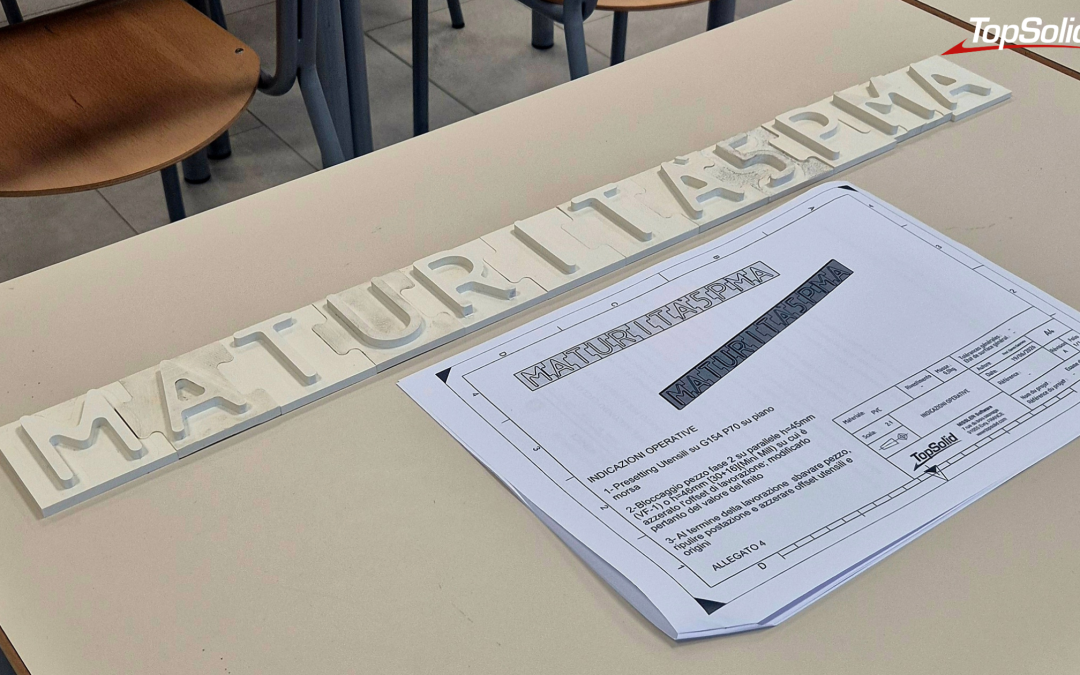
Calculate the stresses in a C43 steel shaft, select bearings from the manual, design a gearbox housing using CAD, define the CAM strategy, and, finally, go to the workshop to set up the part and adjust a CNC machine.

This is not a description of a workplace integration program, but rather the actual topic of the second section of the state exam for the IP13 track—Industry and Crafts for “Made in Italy” (mechanical manufacturing).

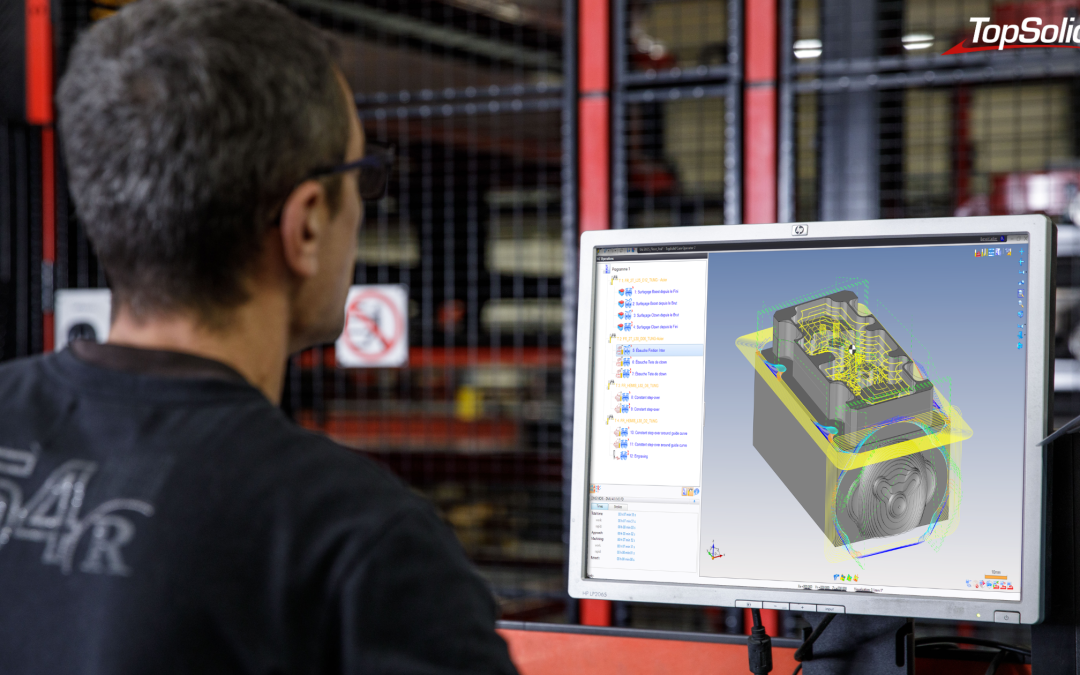
A perfect bridge between the classroom and the Industry 4.0 workshop, which the students crossed by using a comprehensive software suite such as TopSolid.

We interviewed Professor Gabriele Gerini, a lab instructor at the I.I.S. Leonardo da Vinci in Florence, Italy, who guided the students through an experimental project that proved to be successful.


Professor, this year the students took an exam that focused specifically on “Made in Italy” and the local region. What was the exam committee’s objective?

“For our school, this academic year marks the second and final year of the new program, “Mechanical Manufacturing for Made in Italy.” Compared to last year, we have sought to give the exam a more specialized and technical focus; as stipulated by the ministerial decree, the exam is developed by the examination board within a general framework in order to highlight the school’s unique characteristics and the actual training experiences undertaken by the students.”


What skills are actually assessed in an exam of this type?

“An exam structured in this way combines various skills. Students must demonstrate that they have acquired skills in the areas of design, three-dimensional technical drawing, and CAM programming, as well as in the setup and commissioning of CNC machines. I believe that such a well-rounded profile—capable of managing all phases of the product lifecycle—is highly sought after by companies, which today are specifically looking for versatility and competence.”


In your opinion, in the field of mechanical engineering, how important is it to combine CAD/CAM design with mechanical sizing, as opposed to relying solely on theory?

“Successfully giving form to what students study, conceive, and design is fundamental to fostering a more critical and truly enlightened education. In fact, I find that Confucius’s words are more relevant than ever: “If I listen, I forget; if I watch, I remember; if I do, I learn.” Theory is fundamental, but it only acquires value when it becomes a tool for solving a real-world production problem.”


How did the students react when they discovered an exam question so closely related to a real-world industrial case?

“Rather than surprise, I would describe it as a positive realization on the part of the students. Since this was an exam designed by the jury based on ministerial guidelines, the students knew they would be faced with a real-world, challenging scenario, but they had absolutely no idea what the specific content would be. Their composure stemmed from their experience over the past two years—and particularly this past school year—during which we worked extensively on developing concrete projects. By getting them accustomed on a daily basis to transitioning from theoretical and technical study to practical application, they arrived on exam day equipped with the intellectual and operational tools needed to tackle the subject with great maturity.”


>>> See also – TopSolid Education and Industrial Training

What were the most common challenges students faced during their training?

“The students were exposed to a large number of practical cases and a wide variety of technologies. This exam focused specifically on milling, but throughout the year, students completed projects involving turning, laser cutting, and 3D printing, with the goal of integrating all the technologies available at our school into complex projects, while also performing geometric and dimensional measurements and inspections using a coordinate measuring machine (CMM). During their training, they experimented with different programming strategies, the selection of cutting parameters, and machining settings, emphasizing approaches specific to different materials, while keeping an eye on production deadlines and tool sharpening times. The machining operations performed were primarily 2.5-axis, in some cases 4- to 5-axis positioned, with a notable example of continuous 5-axis machining.”


On average, how long does it take for a student to become proficient in using TOPSOLID?

“With an appropriate learning method and consistent motivation to design and produce a variety of mechanical parts, I believe that one school year can be enough to bring students to a level of autonomy that is more than sufficient. In fact, this was confirmed during this first experimental year, when we chose to use TopSolid for the high school graduation exam. Of course, when it comes to more complex machining operations, shapes, or specialized materials, the time required increases; however, I believe the biggest obstacle lies in understanding the underlying logic of the software, which, based on my experience and student feedback, is actually very intuitive.”


What skills distinguish an average student from one who is particularly well-prepared?

“I’m pleased to see that all the students who were trained in the software demonstrated sufficient skill to program a relatively complex mechanical part from scratch, such as the one specified in the exam. For someone in my line of work, that’s the greatest satisfaction: being able to involve everyone without leaving anyone behind.”

“Of course, I am also proud of the exceptional performance our young people have demonstrated, which I am convinced will lead them to rewarding careers. The difference lies in the informed choice of the right machining steps and in the optimal determination of cutting parameters, taking into account machining lead times and the actual availability of tools in the shop. A young person who can integrate all this information and translate it into smooth, efficient programming is undoubtedly ready to take on the challenges of an industry constantly seeking skills at this level.”


When analyzing the topic, we move from calculating stresses (bending and shear) to the CAM machining strategy and tooling. At what stage did the students demonstrate the greatest technical maturity?

“Overall, the students proved themselves at every stage. CAM programming was certainly the biggest hurdle, but they all overcame it with flying colors, and some particularly brilliant students even accomplished this task remarkably well. The most complex part remains the calculation and sizing: let’s not forget that this is a vocational school, which enrolls students with a practical and hands-on focus; having them take such a comprehensive exam was a challenge we wanted to set for them, and they rose to it brilliantly. The stage that pleasantly surprised me the most was the machine setup. All students completed the practical portion entirely on their own, performing the fundamental operations of tool presetting, workpiece zeroing, and program management. Some even made judicious choices when adjusting the compensation radius to meet design tolerances. Completing such a task as part of an exam has a significant impact on anxiety management and performance: an aspect that, as examiners and faculty, we can only commend and value.”


Preparing a class for such a comprehensive exam requires significant teamwork among teachers and a well-structured curriculum. What advice would you give to your colleagues at other schools who would like to implement similarly integrated CAD/CAM programs?

“The planning for this school year was intense, thoughtful, and engaging. The complete integration of hands-on projects with the core subject (Design and Production) created a synergy that allowed each activity to be structured from start to finish, from design to completion. The effort required to set up materials and prepare lessons—all while meeting the deadlines imposed by increasingly tight schedules—is far from simple. But when approached with enthusiasm, it enables us to achieve any goal with the students, rediscovering in them that passion which still makes us believe that school is the place where a person’s character is forged and where dreams and ambitions are built.”

All of this was made possible thanks to the entire TOPSOLID team—from administrative and sales managers to technicians—who never failed to support us. The path ahead is exciting, and as an institution and a mechanical engineering department, we look forward to following it and implementing it more and more alongside future generations of students.


Before concluding, we would like to thank the I.I.S. Leonardo da Vinci in Florence and Professor Gabriele Gerini for sharing this innovative educational experience, which offers a concrete glimpse into how schools can meet the needs of modern industry and prepare young people for the challenges of the future.

Special thanks also go to Benso Tuscany Srl, a TopSolid reseller, and specifically to Gianpiero Sigismondi, whose personal commitment and great dedication made it possible to design, support, and bring this important training project to life. This valuable collaboration has paved the way for a positive future for the school and the local community.

The school’s experience shows that CAD/CAM is no longer just a tool used in the workplace, but can become a central component of education—even at the high school level. Introducing TopSolid into the classroom meant asking students to think like technicians, designers, and production operators, applying real-world skills that are immediately applicable in the workplace.

It has been confirmed that when schools, technology, and pedagogy work in harmony, the line between education and the professional world blurs to the point of nearly disappearing. Thanks to the program they’ve completed with TopSolid, these young people don’t enter the industrial world as beginners: they’ve already acquired the methodology, basic independence, and technical vocabulary needed to quickly integrate into a company and begin their true professional development journey.

And, in an industry constantly seeking skilled workers, this may be the most important outcome of all.

TopSolid’Web Configurator: Configure, Quote, and Sell in 3D Right from Your Browser

TopSolid’Web Configurator: Configure, Quote, and Sell in 3D Right from Your Browser

Photo credits: Design Bois (69), a specialist in high-end interior design, as well as the design and fabrication of custom woodworking solutions, Stéphane Couchet©

Imagine a sales representative who arrives at a customer’s location, opens his laptop, and configures—right there in front of the customer—the exact product that meets their needs, complete with a real-time 3D visualization and a price that updates with every change.

This is what TopSolid’Web Configurator offers—the new web-based solution launched in February 2026 by TOPSOLID. A first in the CAD/CAM ecosystem: a configurator fully integrated with the TopSolid database, with no duplication or re-entry required, and accessible from any browser.

Julien Poirot, product manager at TOPSOLID, discusses the project’s origins, its practical applications, and what fundamentally sets it apart from other web-based configurators on the market.

A “message in a bottle” that found its audience

It all begins at the 2024 Batimat trade show. TOPSOLID discreetly presents a video there showing a web configurator prototype. There isn’t a version to test yet—just a demo to gauge market interest.

The response was immediate. “There was a certain amount of enthusiasm. It reaffirmed our decision,” says Julien Poirot. Contacts are pouring in, needs are becoming clearer, and development is picking up speed.

After a year in the Early Access phase, TopSolid’Web Configurator will officially launch in February 2026 as a stable release: reliable, data-guaranteed, and ready for production use. The product will now be part of TOPSOLID’s annual update cycle.

And it is this same Batimat trade show, next October, that will host its official presentation to the general public.

The Decisive Advantage: A Unified Database

There are plenty of web-based configurators out there. But almost all of them follow the same pattern: a database dedicated to the configurator on one side, and the design office’s database on the other. The result: two systems to maintain, high integration costs, and the risk of discrepancies between what the sales team presents and what the engineering department designs.

Julien Poirot sums up the problem: “Maintenance costs, design costs—everything—are doubling. Whereas in TopSolid, the database is unified. We create things once, and then we can use them across both of our solutions.”

TopSolid’Web Configurator draws directly on existing TopSolid files. Configurable products are designed in TopSolid 7, without the need for redesign or duplicate data entry. Updates from the design department are automatically reflected in the configurator. And since the configuration process directly leverages the power of TopSolid, there is no limit to the possible variants, options, or combinations.

Two uses, one tool

TopSolid’Web Configurator addresses two distinct but complementary needs. The first is sales-oriented, and the second is focused on customer autonomy.

A salesperson armed with a visual sales pitch

During a client meeting, the sales representative opens the configurator on their computer, selects the product options (dimensions, materials, accessories, etc.), and the client instantly sees the 3D model update, with the price recalculated in real time.

Once the configuration has been approved by the client, the 3D files are sent directly to the process engineering teams—unambiguously, without the need for re-entry, and without the risk of misinterpretation.

A self-contained client based on standard configurations

For companies whose teams spend a lot of time on repetitive, low-value-added quotes, TopSolid’Web Configurator makes it possible to redirect part of this workflow directly to customers.

“And if the customer wants to go into more detail about a specific design, you offer to put them in touch with a sales representative—but with a solid foundation to build on,” summarizes Julien Poirot.

This model frees up sales time for more complex projects, without compromising the quality of customer service. Teams focus on areas where their expertise truly makes a difference.

>>>See also – Automation, integration, simulation: A guide to game-changing CAD/CAM trends

The CQS: Formalizing Cost Estimates, Capitalizing on Expertise

TopSolid’Web Configurator includes a pricing engine and CQS (Cloud Quote Services)). It automatically calculates the price of each configuration by applying the pricing rules defined by the company: quantities, options, assembly costs, surcharges, etc.

The issue goes beyond a simple price calculation. “This provides a structure and discipline. “And it allows the company to capitalize on its expertise,” explains Julien Poirot. “Because today, when you have a sales representative who has all the expertise and experience with products and pricing, if they decide to leave, everything is lost. With the configurator, we can establish company policies. This allows for a passing on this expertise. »

The implementation of the CQS also provides an opportunity to formalize rules which were sometimes based on rough estimates. How do you calculate the cost of installing a railing, a staircase, or a complex structure? Discussions around the table result in clear, well-documented, and reproducible rules, regardless of who is preparing the estimate.

Already in production: Echelles Néressy

Thomas Latéulère, industrial designer at Echelles Néressy, a manufacturer specializing in industrial access equipment—including ladders, walkways, and guardrails—has been using it in production for seven months. This deployment in a demanding sector illustrates the solution reached maturity as soon as it was launched.

This type of configurable product—structures whose dimensions, safety options, and installation requirements vary from one job site to another—is precisely where TopSolid’Web Configurator delivers the most value: numerous combinations, specific industry rules, and a need for a compelling visual presentation to clients.

Hosted on your own servers, featuring your brand’s colors

TopSolid’Web Configurator is self-hosted on the customer’s servers. No mandatory use of the cloud, no data transfer through a third party: the company remains has full ownership and control over its configurator and data. Please note: The CQS pricing engine operates through a dedicated cloud service; only the data necessary for price calculations is transmitted through it.

The solution is fully customizable: logo, brand guidelines, catalog, visuals. It is also multilingual, making it a tool well-suited for manufacturers that sell internationally. The goal is clear: for the configurator to be seen as the customer’s tool, not as a TopSolid product.

Three deployment architectures are available, depending on the traffic volume and the need for isolation from the engineering department: centralized, remote, or isolated.

>>>See also Training Tomorrow’s Technicians Using Today’s Tools

TopSolid’Web Configurator is available for all TopSolid business sectors: metal fabrication, woodworking, design, and tooling. Any manufacturer working with products that have options and variants can benefit from it, regardless of which TopSolid module they use.

Would you like to see TopSolid’Web Configurator in action? Contact our team for a personalized demonstration.

Automation, Integration, Simulation: A Guide to Game-Changing CAD/CAM Trends

Automation, Integration, Simulation: A Guide to Game-Changing CAD/CAM Trends

Photo credits: Laser cutting at our client Ferrier (39), a specialist in fine sheet metal work, Stéphane Couchet ©

Shorter lead times, smaller production runs, more complex geometries, and a shortage of technical talent: mechanical workshops are facing an unprecedented accumulation of pressures. In this context, CAD and CAM software are no longer merely design or programming tools. They have become central to the operational performance of industrial companies.

But the sheer number of digital innovations makes it difficult to prioritize. AI, digital twins, additive manufacturing, integrated ERP—where to start… and why? To help clarify things, we spoke with the experts at TOPSOLID. Benoît Lallier, a specialist in CAD/CAM environments, and Alexis Jacquillard, an ERP integration expert, share their take on the major trends for 2026—all without beating around the bush, using concrete examples.

Automation: Say Goodbye to Manual Programming

The first major trend is the automation of repetitive tasks, both in design and machining. AI in the strict sense isn’t yet being used for CAM (with the timeline for the most advanced machining functions being around 2027–2028), but structured and pragmatic automation, available today.

On the CAD front: building on what we’ve already achieved

How much time do we waste redesigning components that we’ve modeled dozens of times? Benoît Lallier identifies this as one of the first levers to activate: the libraries of parameterized components. “If I have a catalog of cylinders from a supplier like Festo and, as a design firm, I need to use them regularly, rather than redesigning the cylinder each time, I add it to my library. Or I import the 3D file directly from the supplier’s website.”

>>>> See also – From the Design Office to the Workshop: How Can We Break Down Silos to Improve Production?

TopSolid also includes smart components that automate the CAD operations related to their placement. “When you place a screw to assemble two parts, it automatically creates the drill hole in the first part and the tapped hole in the second. On a full project, this saves dozens of minutes.”

To take things a step further, you can save generic workflows and operational scripts that can be reapplied to new geometry with just a few clicks, or develop custom automations using TopSolid’s APIs—for companies willing to invest a little time in development.

CAM: From the Tool Library to Boost Milling

The same principle of capitalization applies to machining. The cutting tool libraries centralize the parameters for each tool, whether you build your own database or import them directly from suppliers (Kennametal, Sandvik, Fraisa, etc.) via the ISO 13399 standard. “Some customers assign a dedicated person to create these libraries. The effort is made up front, and then the entire shop benefits from it.”

Once these foundations are in place, the benefits accelerate. A CNC program can be automatically reapplied to new geometry: If the part changes, the machining path is recalculated without starting from scratch, using associative mode. You can also duplicate an entire machining sequence from one part to another that is very similar. “It’s really just copy and paste. All you have to do is copy the relevant faces.”

Among the still underutilized strategies, Benoît Lallier cites Boost Milling (trochoidal machining). “It’s like going from a BMW to a Formula 1 car. You can save up to 70% of roughing time compared to a standard strategy. The main obstacle is often a lack of knowledge: customers who aren’t familiar with the technology don’t buy the right cutting tools. Those who give it a try never go back.”

Automated Manufacturing Files round out the picture. Instead of relying on verbal communication between the programmer and the operator, TopSolid automatically generates a structured document that includes processing times per operation, tool references, tolerances, and 2D drawings. “The operator arrives with a detailed list. Every time he turns a page, he knows exactly what to do. It’s very instructive.”

An Often-Overlooked Issue: The Transfer of Know-How

When an FAO expert retires, their years of experience go with them—unless they have been documented in libraries and recorded procedures.

That’s exactly what TopSolid makes possible. “New employees can reuse what their colleagues have developed, without having to become super-experts themselves.”

>>>>See also – Training Tomorrow’s Technicians Using Today’s Tools

From Silo to Digital Thread: CAD/CAM/ERP Integration as a Competitive Advantage

This is the most transformative trend of 2026—and one of the most underrated. In many workshops, CAD, CAM, and ERP still operate as three parallel systems that don’t really communicate with one another. The consequences are well known, but are often accepted as inevitable.

The Pain of Compartmentalization

Alexis Jacquillard sums it up clearly: “The ERP is the nerve center of a company. That’s where everything flows through. When you have independent databases that don’t use the same reference framework, you don’t know if a reference in one system corresponds to the same reference in the other. We may all be talking, but we’re not speaking the same language.”

Visible costs (re-entry, file conversions, duplicates) are just the tip of the iceberg. Silent errors are often more serious: a discrepancy between the design department’s model and what is actually manufactured, material requirements calculated based on an obsolete bill of materials, or information lost when transferring data from one system to another.

In large organizations, the role of “data manager” is emerging to ensure the consistency of databases. This is a real problem, and it comes at a cost.

What Integration Actually Changes

When the supply chain is based on a single data model, the benefits are measurable within the first few weeks. “Take the case of a manufacturer of specialized machinery. The sales representative takes an order, and the draftsman designs the machine. The production planning department doesn’t have to re-enter everything—it benefits directly from the draftsman’s work. From the design department to the production planning department, we easily save 50% of the time. And there are no data entry errors.”

The connection between FAO and ERP opens up a particularly powerful angle of analysis: the comparison between theoretical time and actual time. The machining time calculated by the CAM system serves as the baseline. Once production begins, the ERP system records the actual time logged by the operator. “If the CAM system consistently estimates three minutes but we’re systematically taking four, we need to figure out why. That shows us where there’s waste in the production process that we could address.”

The integration now covers the entire TOPSOLID ecosystem: CAD, TopSolid’Cam (machining), TopSolid’Cut (sheet metal fabrication), ShopFloor (shop floor management), PartCosting, and Inspection. These modules are natively connected to the ERP system: ShopFloor transmits purchase requirements to the ERP system, which then issues purchase orders and reports the quantities received.

Next step: a stronger integration with Inspection, allowing users to open TopSolid’Inspection directly from the ERP system and scan their drawings; the dimensions to be measured will then be automatically imported into the ERP system.

The “best-of-breed” argument: a direct response

Some industry leaders argue that putting together the best specialized components on the market is superior to an integrated suite. Alexis Jacquillard responds bluntly: “Sure, they can choose the best tools on the market. But they won’t be as well integrated as what we’re doing today. The integration is robust because it’s an internal standard, not a custom development. When customers request updates, we incorporate them, and everyone benefits. With a best-of-breed approach, it’s often a costly custom solution that will need to be refinanced with every new request.”

Added to this is a fundamental argument that current hiring challenges make more relevant than ever: “In the past, executives would say to themselves, ‘It’s no big deal—I’ll just hire someone to re-enter the data.’ Today, hiring at every level is difficult. These interconnections are simply tools that make the process easier. We’ve reached the point where it’s hard to understand why a system isn’t automated.”

Change management: the real obstacle

The main barrier to adopting an integrated system is not technical. It is human. “Changing ERP systems is like changing the way a company is managed. It’s natural to be afraid of that. But an ERP system has a lifespan of between 7 and 10 years. The real question is what we stand to lose by sticking with an outdated system.”

TOPSOLID supports this transition with training, workshops, and skills transfer, with timeframes ranging from three months for a direct production launch to six months for full migrations. These periods also often provide an opportunity to revamping data and processes: “We’re taking advantage of this change to get everything in order. Clients are realizing that their database needed a major cleanup.”

>>>See also See also – Producing Quickly and Well: Industrial SMEs Face the Challenge of Customer Deadlines

Digital Twins and Simulation: From Buzzword to On-the-Shop-Floor Reality

The term “digital twin” has become so overused that it deserves to be grounded in reality. In a machine shop, a digital twin is, above all, a faithful 3D representation of the machine tool, its immediate surroundings, and the parts being machined on it, with sufficient accuracy to ensure that the remote simulation is reliable.

Benoît Lallier explains: “The goal is to have a virtual 3D model of your machine tool so you can perform the most realistic simulation possible. That way, when I’m programming from my desk—without being at the machine—I can already know what the machine is going to do.”

Integrated simulation makes it possible to verify in advance that there are no collisions, to determine the precise cycle times used for costing and sales, to analyze material flows for a given production run, and to balance workloads across machines before the parts go into production. “At some point, the customer thinks to himself: ‘Hey, instead of running this part through the small machine, it would be better to use the one next to it.’ It seems obvious, but in a just-in-time system, it’s not always that simple.”

There are two concrete benefits. In the workshop, the focus time plummets: The operator arrives with a manufacturing specification that lists exactly which tools are to be assembled, along with their dimensions and settings. Outside the workshop, the machine can continue to produce while the programmer prepares the next program—background programming.

Simulation also protects equipment. We’re talking about machines worth hundreds of thousands of euros, cutting tools whose breakage results in immediate costs, and parts made of expensive materials that would end up as scrap in the event of an error. “The goal is to avoid breaking anything. We can quickly detect whether a path will cause a collision before the actual machine is even touched.”

The Post-Processor as the Cornerstone

It is this feature that converts the simulated paths into machine code recognized by the CNC system, without the need for manual corrections. “This is a capability TOPSOLID has honed over more than 40 years. The idea is to deliver a turnkey solution: the customer clicks ‘Send Code’ and doesn’t have to do anything else.”

Additive Manufacturing, 5-Axis Machining, and Hybrid Processes

5-axis machining is becoming more widespread, and with it, the complexity of production runs and strategies. Hybrid machines, capable of alternating between additive and subtractive manufacturing, open up possibilities for geometries that were previously unattainable, while reducing the number of workpiece setups.

These developments do not call into question the previous principles: having a CAD/CAM solution capable of managing these advanced processes without any breaks in the digital chain remain essential for effective implementation. A 5-axis route generated in a tool that is not integrated with the ERP system does not allow you to leverage actual data or fine-tune the associated costs.

TOPSOLID has also integrated robotics in its environment, treating the robot like a conventional machine tool. “We didn’t want to make a distinction,” explains Benoît Lallier. “A customer who programs parts on their machining centers should be able to switch to the robot without having to relearn anything. Aside from the specific configuration settings related to the rotational axes, the logic is the same.”

Collaboration and Skill Development: People Remain at the Center

All of the trends mentioned above have one thing in common: they only achieve their full potential if the teams using them are trained, supported, and able to collectively build on their practices.

So the issue isn’t just about choosing the right tools, but about choosing a software provider capable of providing long-term support: during initial deployment, when upgrading to new versions, and whenever a new business need arises. Furthermore, the new generations of technicians trained on TopSolid represent a tangible asset for companies looking to hire. “The same logic applies everywhere. When they join a company, there’s no learning curve.”

How can we turn these trends into a competitive advantage?

The point isn’t to chase after every innovation at once. It’s to clarify its own challenges (timelines, quality, flexibility, cost control) and map out its current digital chain. Where are the gaps? Where are we losing time, information, and profit margins?

The levers often become apparent on their own: CAD/CAM integration if programming is a bottleneck; connection to the ERP system if re-entering data and variances between theoretical and actual costs are costly; and simulation if fine-tuning on the shop floor takes a long time and scrap is frequent. In each of these cases, The effectiveness of these tools depends directly on the consistency of the digital chain that connects them.

That is precisely where the strength of an integrated suite like TOPSOLID lies: not in being the best component in each segment, but in having all the components work together seamlessly within a common reference framework.

Would you like to assess which automation or integration solutions are best suited for your workshop? Contact our teams for a detailed discussion about your specific situation.

Robots in the Workshop: What If Programming Were No Longer an Obstacle?

Robots in the Workshop: What If Programming Were No Longer an Obstacle?

Industrial robots are becoming increasingly common in machine shops. According to the IFR’s World Robotics Report 2025, 542,000 industrial robots were installed worldwide in 2024—more than double the number from ten years ago. The question is no longer whether robots will become commonplace on the factory floor, but how to truly harness their potential.

Flexibility, reach, and the ability to work on large parts or complex geometries: these are its real strengths. But for a long time, realizing its full potential required mastering a specific programming environment that was disconnected from existing CAD/CAM tools. TopSolid’Cam Robot is a game-changer.

Launched a few years ago and set to be fully implemented in 2026, this module integrates robotics directly into the TopSolid’Cam environment, seamlessly building on the existing system, without requiring an additional learning curve, and with all the simulation capabilities that users are already familiar with. Benoît Lallier, CAM Product Manager at TOPSOLID, explains the philosophy behind it.

Why Robot Programming Is Still Holding Back Its Adoption in the Workshop

In a workshop equipped with conventional machining centers, programming is a well-established process: linear movements, X/Y/Z axes, table rotations. This is the daily routine for 95% of TOPSOLID customers. When a robot is added to this environment, the temptation is to use specialized software for it, which involves a dual expertise for the programmer, a dual database for the company, and, inevitably, disruptions in the digital chain.

Industrial robots offer complexity and flexibility, since their multi-axis kinematics are fundamentally different from those of conventional machines. But this complexity should not be passed on to the programmer. This insight has guided the development of TopSolid’Cam Robot since its launch. This is precisely what the offline programming: Design and validate a robot program from your desk, without halting production, while the cell continues to produce.

The philosophy: viewing the robot as a machine just like any other

“We’ve been developing this technology over the past few years with a clear goal in mind: to make no distinction between a robot and a conventional machine tool,” explains Benoît Lallier. “For a customer who programs parts on their machining centers, it’s intuitive.” When it’s run on a robot, there’s no disruption. There are a few specific parameters related to the robot’s axes of rotation, but the workflow remains exactly the same.”

This philosophy shapes the entire design of the module. Rather than creating a separate tool, TOPSOLID has integrated robotics into the same framework as milling, turning, and 5-axis machining: same interface, same tool libraries, same simulation environment, same post-processor. The robot simply becomes another machine in the fleet, with its own kinematic parameters.

The impact on teams is immediate. The skills acquired during TopSolid’Cam training can be directly applied to robot programming. The only additional training required is a course dedicated to learning how to operate the robot and its work cell. Since the software automatically handles the complexity of multi-axis movements, the learning curve is greatly simplified.

Cutting tool libraries, saved methods, and standardized machining sequences: all of the company’s digital know-how can be directly reused on the robot. These are not two separate worlds; rather, there is a single programming environment, extended to a new machine.

TopSolid’Cam Robot’s Key Features in 2026

2D, 3D, and 5-axis continuous paths

TopSolid’Cam Robot generates complex toolpaths in 2D, 3D, as well as in 4 or 5 continuous axes with precision tailored to industrial requirements, regardless of the type of robot used. The part’s geometry determines the toolpath, just as it does on any conventional machine in TopSolid’Cam.

Automated Deburring and Other Robotic Applications

TopSolid’Cam Robot covers the full range of robotic machining operations: drilling, milling, contouring, and deburring, in 2D, 3D, and 4- and 5-axis continuous machining, with or without additional axes.

Deburring is one of the most immediately valuable applications of robotics in the workshop. It involves repetitive operations that are physically demanding for operators and often difficult to standardize on complex parts: this is exactly the type of task for which a robot provides clear added value.

TopSolid’Cam Robot includes automatic detection of edges to be deburred. The software identifies the relevant areas on the part and generates the corresponding toolpaths without requiring manual intervention to define each path. For companies that process series or families of parts, the time saved in programming is considerable.

Simulation and Safety

As with any machine tool in TopSolid’Cam, robot programming is based on a complete digital twin: 3D representation of the robot, its immediate surroundings, parts, and tools. Before sending any code to the robotic cell, the programmer simulates all of the movements.

Two problems specific to robotics are handled automatically. The collisions are detected early on, just like on any machining center. The singularities, these situations—where the robot temporarily loses a degree of freedom, causing unpredictable movements—are automatically identified and avoided by the software. The result: a smooth and safe process, with no surprises on the shop floor.

The post-processor

As with conventional machine tools, TOPSOLID develops and maintains certified, customizable post-processors for all robots on the market, regardless of programming language—whether ISO or proprietary.

These post-processors convert the simulated paths into a language that the robot controller can directly recognize. The programmer clicks “Send Code,” and the robot executes the commands without any corrections.

“That’s where we deliver a turnkey solution, tailored to the client’s exact needs,” explains Benoît Lallier. “The client shouldn’t have to correct anything.”

>>> See also – Technology Watch: CAD/CAM Trends That Are Redefining Industrial Competitiveness in 2026

Native integration into the TopSolid digital workflow

One of TopSolid’Cam Robot’s most significant strengths is its native integration into the TOPSOLID ecosystem. The robotic cell is not an isolated island within the company’s information system.

Robot programming data is stored in the same PDM (Product Data Management) than conventional machining programs. Parts designed in TopSolid’Design data is imported directly into robot programming—including average dimensions—for machining that meets the tightest tolerances—without any conversion or re-entry.

Product lines, tool libraries, and manufacturing files: everything is generated in the same environment and shared through the same repositories.

TopSolid’Cam Robot is primarily intended for workshops that are already equipped with industrial robots—or are planning to be—and that do not want to duplicate their programming environment.

The most common applications involve operations that require high ergonomic value or repetitive precision: automated deburring, milling of large parts, and multi-face operations on complex geometries.

The flexibility of robotic arms, combined with the programming capabilities of TopSolid’Cam, opens up possibilities that neither the robot alone nor a conventional machine tool can provide.

>>>See also – From the Design Office to the Workshop: How Can We Break Down Silos to Improve Production?

TopSolid’Cam Robot in 2026

After several years of development, TopSolid’Cam Robot reached a level of maturity in 2026 that justifies its confident adoption in production. Recent developments have notably enhanced the generation of complex continuous toolpaths, the handling of singularities, and programming ergonomics to make the experience as close as possible to that of a conventional machine tool.

Benoît Lallier sums up the goal: “Programming must be simple, fast, and reliable. There should be no difference between programming a robot and programming a machining center. That’s the challenge we’ve taken on.”

Are you already a TopSolid’Cam user and interested in exploring robotic machining? Contact our teams for a detailed discussion about your setup.

Training tomorrow’s technicians to use today’s tools

Training tomorrow’s technicians to use today’s tools

At TOPSOLID, our commitment to the education sector goes beyond simply providing software licenses. It is a deeply held belief: A French industrial software company has a responsibility to support those who are training the technicians and engineers of tomorrow.

To better understand this philosophy and learn how it plays out in practice, we spoke with Vincent Vogel, TOPSOLID’s Sales Manager for Education, who has been working for several years to build lasting relationships between the software company and educational institutions.

An educational commitment rooted in the company’s history

For a long time, the relationship between TOPSOLID and the education sector was based more on individual initiative than on a structured strategy. It was in the 2000s that a position dedicated to education was created within the company—a strong signal from a software publisher that viewed training as a strategic priority in its own right.

The reasons are both pragmatic and philosophical. Pragmatic, because learners who have been trained to use a particular tool naturally tend to stick with it when they enter the workforce. Philosophical, because TOPSOLID is one of the few software companies CAD/CAM to develop all of its solutions in France.

“We are a French publisher, developed in France, with a very French approach,” explains Vincent Vogel. “We have a real responsibility to be present in schools and to support both teachers and students.”

Today, more than 500 institutions in France are part of the TOPSOLID network, covering a wide range of educational needs—from vocational high schools to university technology institutes (IUTs), including HND programs and engineering schools.

See also Recruitment in Industry: Attracting Young Talent Through Innovative Production Tools

The Driving Simulator: When an Educational Project Becomes a Collective Adventure

Every year, TOPSOLID strives to produce a feature highlighting a project created by students using its software. Following a prosthetic hand and a wooden guitar exhibited at Eurobois, this year’s project is a dynamic driving simulator that was selected for this new edition… and the project far exceeded initial expectations.

The Beginning: A Meeting, a Vision

It all began with a visit to Monge High School in Chambéry, a comprehensive high school that offers a sheet metal and boilermaking program. Vincent Vogel, a TOPSOLID field representative, met with the teaching staff there and established a connection with Édouard Vaillant High School in Limoges, which had already built its first driving simulator.

The idea then became clear: Why not bring the two schools together for a much more ambitious inter-high-school project and design a new version of the simulator featuring TOPSOLID’s branding?

TOPSOLID from A to Z: From Design to Manufacturing

What makes this project particularly remarkable is that the entire TOPSOLID digital chain was brought into play:

  • Using 3D CAD design, we were able to model every part of the simulator, make corrections to its base, and optimize the assemblies before any physical manufacturing took place.
  • The FAO then took over responsibility for controlling the machine tools and manufacturing the parts.
  • The entire project was centralized and managed through PDM (Product Data Management), ensuring data consistency between the two facilities.

In other words, the students worked exactly like industrial design engineers, with the same constraints, the same tools, and the same level of precision.

A Project That Brings People Together

After months of working in parallel at each high school, a gathering was held on March 18 to assemble the entire simulator for the first time. It was a memorable moment, later capped off by a group painting session that gave the simulator its final look.

The centerpiece was then displayed at the Global Industrie trade show, where it generated remarkable enthusiasm. “We received a lot of feedback from people all over France, not just from the high schools involved,” notes the Education Manager. “Visitors were blown away by the quality of the work.” A designer had offered some aesthetic advice beforehand. The result? The simulator stole the show.

See also – TopSolid’Wood in Education

What the project Really Taught Them

Beyond technical skills, this project gave the students something that traditional education cannot always provide: the pride of working on a real project intended to be showcased to the general public. “The students were excited about the opportunity to work on a real-world project with TOPSOLID that would be showcased at a trade show,” says the Head of Education.

The teachers, too, gave it their all. Motivated by the Global Industrie deadline, they worked twice as hard to stay on schedule—without anyone imposing any deadlines on them. One of them even organized a week-long ski trip… strategically timed just before the visit to Lycée Monge. This friendly balance says a lot about the overall atmosphere of the project.

TopSolid’Academy: A Community for Educators

In addition to its field projects, TOPSOLID launched TopSolid’Academy last September, a platform dedicated exclusively to teachers. The goal: to provide them with a space for educational resources and peer-to-peer exchange.

Specifically, the platform offers:

  • TOPSOLID resources and content available for free (tutorials, course materials, software news),
  • a community for educational exchange where members can share assignments, lesson plans, and feedback.

The numbers speak for themselves: in just a few months, more than 300 teachers have signed up, and the platform has already been downloaded more than 4,000 times. This launch confirms the genuine need for such a space within the teaching community.

A National Competition for IUTs: The Finals in Bordeaux

Another flagship initiative: an internal competition for IUT students in the Mechanical Engineering and Manufacturing Technology (GMP) program, with a focus on CNC machining. More than 70 candidates from across France took part in the selection process for this inaugural edition, and the final will be held on May 21 at the IUT in Bordeaux. A great opportunity for students to test their proficiency with TOPSOLID in a competitive and rewarding setting.

A simple philosophy: the tool should take a back seat to the craft

Ultimately, what guides TOPSOLID’s entire educational approach can be summed up in a statement by its Head of Education: “When we train students for a profession, we aren’t training them to use software.”

Ideally, the tool should be the one that will actually be used in the workplace, and it must be intuitive enough to allow the teacher to remain a professional trainer—not a software trainer. This is precisely the stated intention of TopSolid V7: user-friendly, affordable, widely used in industry, and well-suited for educational purposes.

To address the budgetary constraints faced by educational institutions, TOPSOLID has also established a clear principle: no educational project should be held up by cost considerations.

TOPSOLID Education offers competitive pricing and adapts to the specific needs of each institution to provide tailored solutions while maintaining the necessary support and follow-up, just as it does for industrial clients.

Conclusion: Investing in training means investing in French industry

TOPSOLID’s commitment to education is not just a public relations ploy. It reflects a corporate and social conviction: French software that trains today’s technicians directly contributes to tomorrow’s industrial sovereignty.

The driving simulator developed by Lycée Monge and Édouard Vaillant is the most concrete example of this. When high school students spend months designing, building, and assembling an ambitious project using the same tools as professionals—and capture the imagination of visitors at a major industrial trade show—it makes the entire field more appealing.

“When I talk to young people who tell me they love TOPSOLID, it really makes me happy,” the Education Manager says simply. That one sentence speaks volumes about what truly drives this long-term commitment.

Are you a teacher or an educational administrator looking to equip your school or join TopSolid’Academy? Contact our education team! No project should be held up by budget issues.

TopSolid’Inspection: Optimizing Quality Control Without Disrupting the Digital Workflow

TopSolid’Inspection: Optimizing Quality Control Without Disrupting the Digital Workflow

Photo credit: Ferrier (39), a specialist in precision sheet metal work, Stéphane Couchet©


While manually re-entering dimensions is a routine and repetitive task, it nonetheless remains a source of hidden and costly errors. And for good reason: in many workshops, despite the stakes, quality control remains a step disconnected from the rest of the digital workflow. The result: data traveling on paper, measurements transcribed by hand, and nonconformities discovered too late. What if we integrated quality control directly into the digital workflow, from CAD to the shop floor? That is the true strength of TopSolid’Inspection. Discover it.

Quality Control: An Island in the Middle of the Digital Ocean


In traditional environments, inspection is a standalone step. It relies on its own tools, files, and repositories, independent of the digital tools already in use in the workshop. This isolation creates several points of friction:

  • re-entering dimensions from CAD drawings into inspection procedures,
  • incorrect application of standards (general tolerances, adjustments, sampling, etc.),
  • risk of errors with every data transfer,
  • assigning an employee to low-value-added tasks,
  • delays in identifying nonconformities.

However, this is not a matter of a lack of human diligence, but rather a flaw in the digital architecture of the production line.

Automated Meter Reading: Fewer Steps, Greater Reliability


On the shop floor, every incorrectly marked dimension is a potential nonconformity. Because when a quality inspector has to identify, mark, and organize dozens of measurement points on a complex drawing, even the slightest error can trigger a dangerous snowball effect, affecting the entire production chain.

TopSolid’Inspection eliminates this margin of error by working directly on the 2D drawing. The software imports the part drawing, regardless of its format (PDF, DXF, DWG, scanned image, TIFF, etc.), and then creates dimension calls either manually or automatically.

The built-in OCR technology captures dimension values, generates the corresponding tolerances based on defined standards, and locates each measurement point on the drawing. As a result, what might previously have required an hour of meticulous preparation now becomes a guided, repeatable, traceable, and reliable process.

The checklist is then generated without the need to re-enter data, and data reliability is no longer dependent on an operator’s concentration at the end of their shift. It is also structural—in a positive sense this time.

>>> See also—What are the benefits of automating the parts inspection process?

Quality Control: From Speed Bump to Performance Booster


There’s a persistent misconception: quality control is time-consuming and tends to slow down the workflow. That’s true… when it is poorly integrated—that is, when records are kept on paper, data is processed in Excel, and every change in the series requires recreating a control range from scratch.

In contrast, with TopSolid’Inspection, inspection keeps pace with production. The shop floor interface, deployed on a tablet, supports the quality control technician directly at his workstation. Measurements are entered using the touchscreen keyboard or, better yet, via connected measuring instruments. Trends are therefore displayed in real time, and dynamic control charts can flag any deviations immediately. And since deviations are detected earlier in the process, prevent nonconformities, thereby reducing production costs.

Finally, the quality control specialist is no longer held back by tedious tasks. He is guided through his session of He measures and analyzes, and transcription errors disappear. His role is therefore no longer a cost center; instead, he becomes a a lever for measurable performance.

Ensuring production safety without complicating the organization


Beyond ensuring compliance with customer requirements, quality control plays a key role in traceability within an environment subject to ISO certification and regular audits.

That is why TopSolid’Inspection centralizes all inspection data in a single database that can be directly integrated with existing ERP and CAPM systems. Each measure is automatically associated with:

  • its controller,
  • the instrument used,
  • the date and time of the transaction,
  • the machine in question.

A multi-criteria search system also allows you to instantly find any information by project, by client, by control method, or by date.

This accessibility of information helps clarify the organization. Quality data, which until now had been scattered across Excel files and physical notebooks, become usable, comparable, and auditable with just a few clicks. And since the system supports multiple data sources (shop floor feedback, 3D machine reports, connected devices, etc.), the digital transition can take place at each company’s own pace and without any abrupt disruptions.

TopSolid’Inspection, an application integrated into the TopSolid ecosystem


No matter how effective it may be, a third-party quality control tool remains, as its name suggests, a third-party tool. This means you have to populate it with data, integrate it with CAD software, manage discrepancies in reference systems, and maintain consistency between two environments that do not naturally “speak” the same language… All of these constraints are not only a source of friction but also pose a risk of additional errors.

TopSolid’Inspection works differently. The software is integrated with TopSolid’Design and TopSolid’Erp: the inspection data comes directly from the CAD data. The dimension that the inspector checks on the shop floor is therefore the same dimension that the design department defined during the design phase. The same value, in the same frame of reference, throughout the entire chain.

This digital continuity optimizes the preservation of data integrity by reducing the risk of error and eliminating all sources of error from design through inspection. It is also part of an approach Integrated digital factory: TopSolid’ShopFloor for control, TopSolid’ERP for production management, TopSolid’Inspection for quality control… Each module has been designed to seamlessly interface with the next.

See also—TopSolid’Inspection: Automated and Reliable Quality Checks>
>

>

Integrating quality control with CAD isn’t just about adding another tool to the software chain. It’s about addressing a subtle digital disconnect that causes errors, wastes time, and hinders traceability. With TopSolid’Inspection, quality is seamlessly integrated into the digital workflow without slowing it down. Your production speeds up, and your customers gain confidence. As for your quality team, it can finally focus on what really matters: analyzing, improving, and anticipating.

Would you like to see TopSolid’Inspection in action? Contact us for a demo.