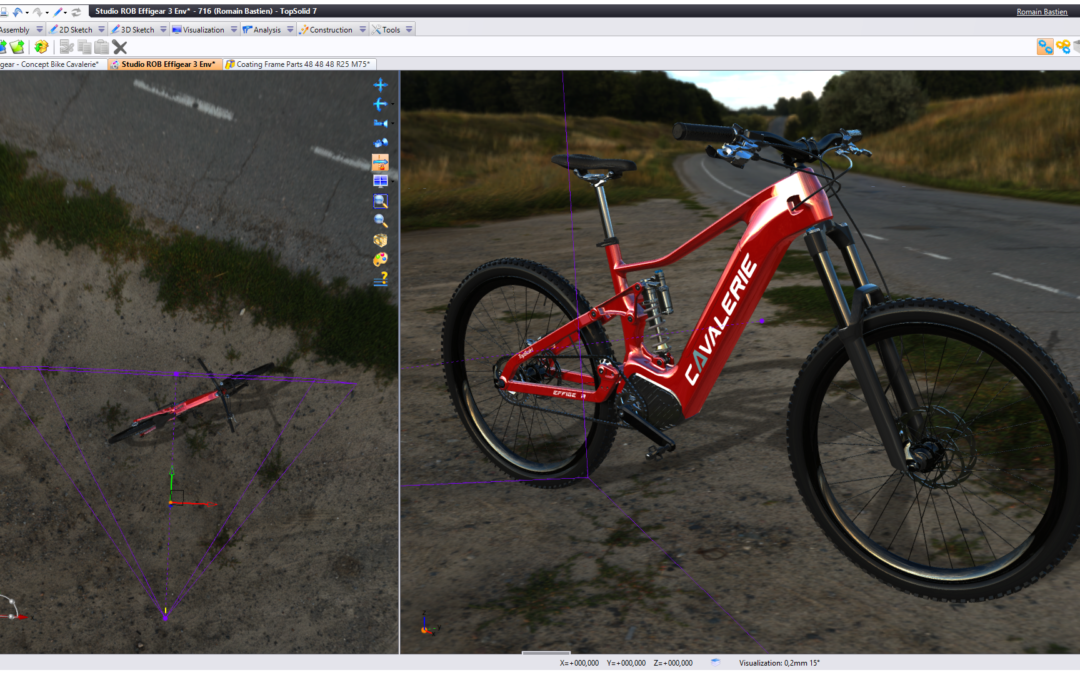
© Effigear
Think of a cube. Great! You’ve just done some 3D modeling. This technique, which became popular in the 1990s, allows you to create three-dimensional virtual representations of objects, buildings, characters, and much more. It plays a vital role in many fields, such as architecture, industrial design, animation, video games, and even fashion. According to Fortune Business Insights, the 3D mapping and modeling market was estimated at $6.77 billion in 2024 and is projected to reach $7.60 billion in 2025, with a compound annual growth rate of 16.5%.
What is 3D modeling?
To provide a somewhat precise definition, 3D modeling is “the process of creating virtual three-dimensional objects using specialized software.” It allows objects to be represented realistically by adding details, textures, colors, and physical properties.
3D models can be created from scratch or by using 3D scanning techniques to capture real-world objects. These models can be viewed from different angles and at different scales, which facilitates analysis, design, and the communication of ideas.
3D modeling could be described as the creation of a three-dimensional virtual world in which objects come to life through realistic shapes and textures. It’s as if you were building an imaginary universe out of digital building blocks, where each element can be manipulated and viewed from every angle.
3D modeling is a way to give shape to the imagination, to bring abstract ideas to life, and to make them tangible in a virtual space. You create a mental landscape by using digital tools to sculpt and shape forms that exist only in your mind, and you can share them with others, who can in turn explore them.
3D modeling is a window to endless possibilities, where creativity can flourish and digital worlds come to life.
In what fields is 3D modeling useful, and what is it used for?
3D modeling is used in many fields. The best-known ones include architecture, industrial design, animation and special effects, video games, and engineering:
- Architecture: Architects use 3D modeling to create realistic virtual representations of buildings and structures, enabling better visualization and communication of architectural concepts.
- Industrial Design: An essential part of the product design process, 3D modeling allows designers to create virtual prototypes and conduct tests and simulations before actual production begins.
- Animation and Special Effects: In the film and animation industry, 3D modeling is used to create breathtaking characters, sets, and special effects. And they’re getting more and more breathtaking!
- Video Games: Video game developers use 3D modeling to create immersive virtual worlds, characters, and interactive objects.
- Engineering: 3D modeling is also used in engineering to design parts, machines, and complex systems, making it possible to detect design errors and optimize performance before manufacturing.
- Marketing and Advertising: 3D imagery is used in advertising campaigns to present products in an appealing and realistic way. 3D renderings allow for a more immersive and compelling demonstration of a product’s features and functionality.
- 3D Printing: 3D modeling is closely related to 3D printing. 3D models are used as the basis for creating physical objects using 3D printers. 3D modeling software allows users to design and prepare the files needed to print the desired objects.
The TopSolid Suite of CAD, CAM, and ERP Solutions



What are the benefits of 3D modeling?
Being able to visualize an object, a shape, a character, or a landscape in three dimensions immediately seems like a lot of fun. Just ask your kids! But it’s much more than that. There are many very practical benefits to 3D modeling:
- Simplification of the design process: Thanks to the use of advanced software (particularly 3D CAD), 3D modeling helps simplify the design process.
- Visualization and Simulation: 3D modeling is used in fields such as film, television, video games, architecture, construction, product development, science, and medicine to visualize, simulate, and render designs. It allows for the creation of realistic three-dimensional models and facilitates the communication of ideas.
- Accuracy and Quality: 3D renderings offer higher quality and greater accuracy than 2D renderings. 3D modeling allows for the creation of realistic perspectives and makes it easier for both professionals and novices to understand projects.
- Cost Reduction: 3D modeling can help reduce costs in the design process. By providing better visualization and simulation of projects, it helps identify errors or potential problems earlier, thereby avoiding subsequent correction costs.
- Accelerating Product Development: 3D printing, which is an application of 3D modeling, makes it possible to create prototypes more quickly and efficiently. This technology facilitates the transition from design to physical production, which is particularly beneficial for product development.
- Facilitating Communication: 3D modeling in virtual reality (VR) offers new ways to communicate ideas and present projects. It provides a more realistic and interactive experience, leading to a better understanding and a more engaging experience.
- Improved Collaboration: 3D modeling facilitates collaboration among the various stakeholders in a project. Three-dimensional models enable better understanding and coordination among teams, which fosters collaboration and reduces communication errors.
What tools can be used for 3D modeling?
Would you like to try 3D modeling, but aren’t sure which software to choose? Here are the most popular ones:
- TopSolid: 3D modeling is at the heart of TopSolid CAD software. It includes solid and surface modeling tools that enable users to create complex parts and express their creativity. Its wide range of features, designed to meet the needs of all industries, makes it the ideal partner for engineering design firms.
- AutoCAD: Used in the fields of architecture, engineering, and construction, this 3D modeling and drafting software offers advanced features for creating accurate and detailed 3D models.
- SolidWorks: Primarily intended for designers and engineers, SolidWorks is a widely used 3D CAD software program for creating 3D models, assemblies, and technical drawings.
- Blender: A versatile 3D modeling, animation, and rendering software. It is used in many fields, including film, video games, animation, and artistic creation.
- SketchUp: For architecture, interior design, and object modeling. SketchUp lets you quickly create 3D models and explore different design options.
Once 3D models have been created, visualization becomes essential for effectively testing and presenting projects. Tools such as Weviz, which specializes in immersive industrial visualization, and TopSolid’Virtual, which offers interactive virtual reality experiences, allow models to be projected into a realistic environment, facilitating decision-making and communication.
The TopSolid’Predict module goes even further by anticipating modeling commands using local AI, which significantly speeds up the design process.
3D modeling is constantly evolving. Software is becoming smarter and more intuitive, and is now integrated into end-to-end production processes, from design to the shop floor. Thanks to virtual reality and artificial intelligence, professionals are becoming more efficient, responsive, and able to deliver higher quality work.
And to get the most out of these tools, training remains essential. Find out how to build your skills or help your teams grow with our CAD training courses.