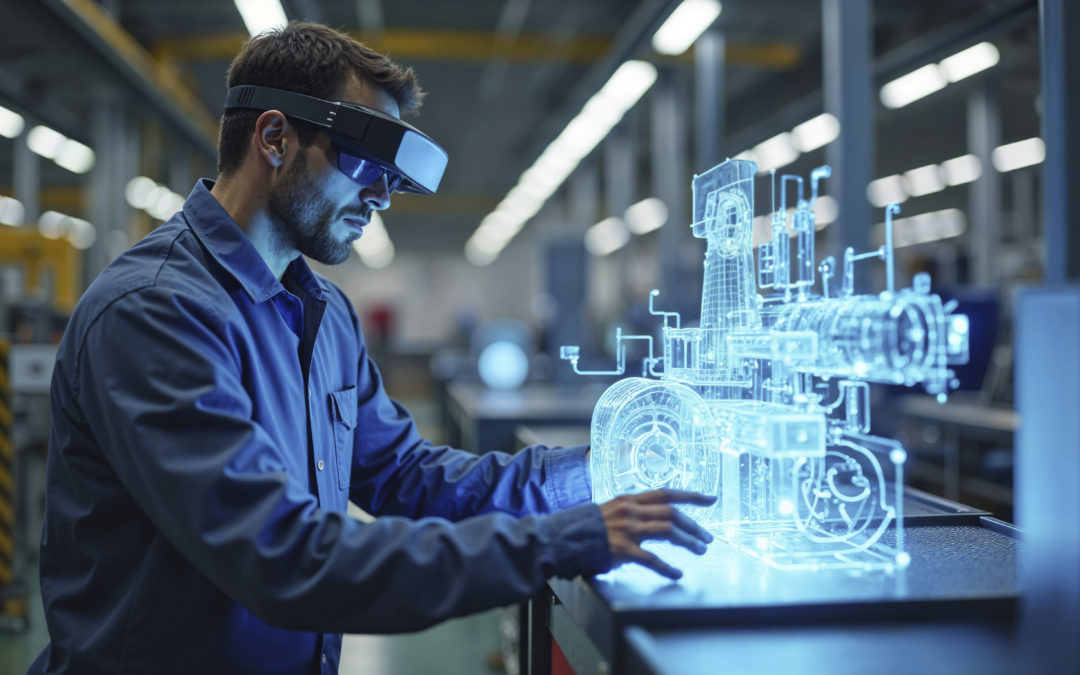
Often associated with video games or immersive entertainment, virtual reality today goes far beyond these consumer applications. In the context of Industry 4.0, industrial virtual reality is becoming a strategic tool for simulation, training, production, and collaboration.
The concept is based on immersing a user in a fully digital environment. Using virtual reality headsets, the operator views a 3D world with which they can interact in real time. This environment can simulate a workstation, a machine, a production line, or a maintenance scenario.
What is industrial virtual reality?
Industrial virtual reality (or Industrial VR) allows companies to place their employees in simulated operational environments. It is clearly distinct from augmented reality, which superimposes digital elements onto the real world. Here, the immersion is total: the entire environment is modeled.
This type of solution relies on a combination of hardware (headsets, controllers, sensors) and 3D modeling software. It is part of a digital workflow and can directly utilize data from CAD, CAM, or ERP systems.
The sectors that are the first to adopt this technology are those that need to anticipate, validate, and secure complex operations: aerospace, automotive, healthcare, and architecture. But more and more industrial SMEs are seeing it as an accessible tool for optimization.
What is industrial virtual reality used for?
Use Simulation to Produce Faster and Better
Thanks to immersive simulation, operators can rehearse production sequences without halting the actual production line. They validate technical procedures, identify risk areas, and adjust processes. This proactive approach reduces errors, shortens cycle times, and improves coordination between workstations.
Repetitive or high-value-added tasks are performed with greater precision. Industrial virtual reality is becoming a tool for operational excellence that drives productivity.
Train without tying up resources
Technical training is one of the most immediate applications of industrial virtual reality. Training takes place in a virtual environment that is identical to the real world, using interactive scenarios. Operators can practice before equipment is installed or before working on critical systems.
The instructions are integrated into the module and presented in a clear and engaging way. The result: faster learning, better retention, and quicker skill development.
Reduce errors and improve quality
One of the major benefits of industrial virtual reality is the ability to identify inconsistencies or risks in processes early on. By visualizing assembly or manufacturing steps, operators can correct potential errors before they actually occur.
This results in a reduction in scrap, product recalls, and associated costs. It also serves as a quality control tool, particularly in certified or highly regulated environments.
Facilitate maintenance and technical support
Virtual reality makes it possible to simulate maintenance scenarios (part replacement, adjustments, cleaning, etc.). Technicians can use it for training or as a reference during service calls. Machine downtime is reduced, and service errors are minimized.
It also facilitates remote support. Experts can guide a field team by sharing the same virtual environment, providing precise instructions without having to travel. This reduces diagnostic and response times.
Design and Validate Using Simulation
Even before moving into production, industrial virtual reality is a powerful tool for prototyping and collaborative design. Teams can manipulate 3D models, test layouts, simulate workflows, detect collisions, and anticipate constraints.
This approach eliminates the need to build physical prototypes, which are costly and time-consuming to produce. It allows for rapid adjustments early in the process, thereby reducing time to market.
TopSolid’Virtual: Industrial Virtual Reality Integrated into Your Tools
The use of industrial virtual reality becomes even more powerful when it is directly integrated with design and production tools. This is what TopSolid’Virtual offers—a virtual reality module that is interoperable with TopSolid’s CAD, CAM, and ERP solutions.
Thanks to this integration:
- The design data can be used directly in VR.
- The simulations are based on reliable and up-to-date information.
- Digital continuity is guaranteed, with no need to re-enter data.
TopSolid’Virtual transforms virtual reality into an industrial management tool accessible to companies of all sizes. The technology serves as a catalyst for transformation, aligning with goals related to digitalization, security, and performance.
The TopSolid Suite of CAD, CAM, and ERP Solutions



A solution tailored to the challenges faced by manufacturers
Industrial virtual reality, far from being just a gimmick, addresses the real-world challenges faced by technical directors, production managers, and SME owners:
- How can we produce faster, with fewer errors?
- How Can We Provide Effective Training Despite the Labor Shortage?
- How can we justify investments in industrial infrastructure?
- How can we remain competitive while reducing the costs of nonconformity?
By leveraging a solution like TopSolid’Virtual, the company integrates VR into its existing environment seamlessly, without excessive technical complexity, and with a measurable return on investment.
Want to learn more about industrial virtual reality as it applies to your business? Our experts will work with you to identify the relevant use cases and implement a practical solution tailored to your challenges.