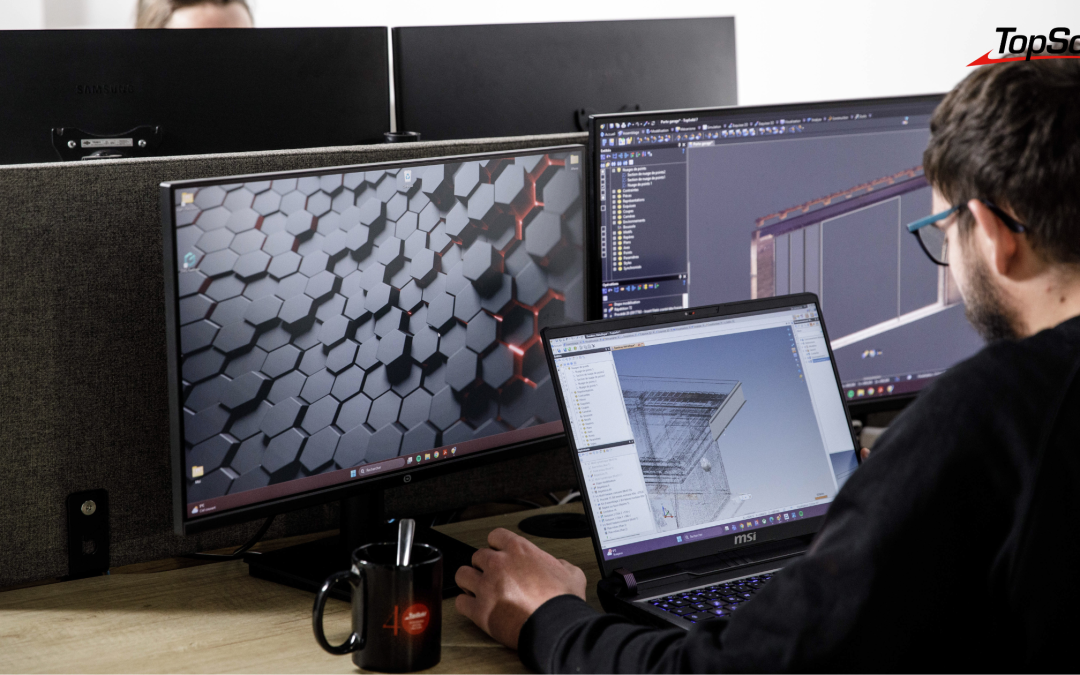
Photo credit: MSK (51), a metalwork specialist that designs and manufactures custom staircases, gates, and glass canopies, Stéphane Couchet ©
Excel remains the preferred management tool in many industrial SMEs. Versatile and familiar to everyone, it seems to meet all needs. However, behind this apparent simplicity lie major risks to competitiveness and compliance. Between data entry errors, multiple versions, and a lack of real-time traceability, spreadsheets are showing their limitations when it comes to meeting today’s market demands. It’s time to explore alternatives tailored to the realities of SMEs.
Excel: The Indispensable Swiss Army Knife for Industrial SMEs
Used in most industrial small and medium-sized enterprises, Excel is mastered by all generations of shop floor supervisors and operators. It is recognized for its remarkable versatility, as it allows users to manage quotes, calculate costs, plan machine utilization, track production orders (POs), analyze overall equipment effectiveness (OEE), and even create dashboards. All of this can be done without any additional investment, since the tool is included in the Office suite, which is often purchased for all administrative and sales tasks.
When Flexibility Becomes a Trap
However, despite its widespread use at all levels of the workshop (from operators to managers), Excel also has its limitations. Among the challenges frequently encountered are broken formulas, broken links between files, and data accidentally overwritten—and this list is by no means exhaustive. Add to this the proliferation of versions, which can cause conflicts in document management and, by extension, in the production chain.
The consequences are numerous and costly:
- time spent on manual consolidation and cross-checks,
- decisions based on outdated data,
- the growing complexity of the process for welcoming newcomers, who struggle to navigate the multitude of files and data recorded in an increasingly fragile system.
Audits and Traceability: When Excel Puts Your Certifications at Risk
While Excel has been widely adopted and has proven its worth on the shop floor, it also appears to have reached the end of its useful life and is no longer suited to the industry’s requirements. Traceability standards are indeed becoming increasingly stringent, yet it remains impossible to guarantee data integrity with Excel.
One thing leading to another, customer relations are also compromised due to longer response times when complaints are filed.
The result: companies risk losing their certifications, being excluded from bids, and facing contractual penalties. It’s a tricky combination with serious financial repercussions.
>>> See also – Industrial Traceability: How Can You Improve the Quality of Your Products and Processes?
Technical and Financial Risks of Excel
Aside from potential data entry errors, the data entered into Excel actually comes from design and manufacturing systems: CAD drawings, bills of materials, and production work orders. This manual re-entry breaks the digital continuity and creates a dangerous gap between design and production.
In this scenario, it is possible that the design department might make a change to dimensions or materials that is not reflected in the workshop’s Excel files. This discrepancy would result in production being launched based on outdated information and lead to nonconformities, whereas TopSolid automatically updates bills of materials and work instructions.
Similarly, specifying a new material requires a manual recalculation of machining times and costs. In Excel, simply omitting a single cell can cause the quote to be truncated. However, with TopSolid, the recalculation is automatic thanks to the material libraries.
Migrating Without Turning Everything Upside Down: A Gradual and Controlled Transition
Given these findings, the temptation to maintain the status quo remains strong. Transitioning to a new system is daunting: it requires a significant investment, faces resistance to change, and carries the risk of disrupting production during the transition… However, a methodical and gradual approach makes it possible to ensure a successful digital transformation without disrupting the workshop’s operations.
The first step is to identify the critical processes that need to be secured as a priority. Work orders, bills of materials, and production schedules are generally the top three priorities. Once these foundational data sets are reliably stored in a centralized system, they eliminate a large portion of the risks mentioned earlier. Rather than undertaking a radical digitization effort, it is therefore better to start with a limited scope (a pilot workshop, a production line) and then expand gradually.
When it comes to choosing a tool, small and medium-sized businesses often assume they need a complex and expensive ERP system to take the plunge. However, digital continuity solutions such as CAD, CAM, PDM, and ERP—like TopSolid—offer a logical alternative: they secure and automate data updates throughout the entire data lifecycle. This eliminates the need to re-enter information from CAD models into Excel.
The benefits become apparent quickly: a drastic reduction in data entry errors, the time spent searching for information cut by two or three, and renewed confidence in shared data.
However, change management remains crucial. Teams need to be trained, involved in setting up the new tools, and see their initial successes recognized in order to better embrace this change.
Finally, such a change is not intended to eliminate Excel from the landscape. Rather, it is about restoring Excel to its proper role: that of a tool for ad hoc analysis and simulation, rather than a mission-critical management system.
>>> See also – CFAO: 3 Reasons Not to Neglect Customer Service and Training When Choosing a Solution
From Theory to Practice: A Successful Transformation in 6 Months
Several success stories illustrate how such a transition can be successfully managed. Generally speaking, the starting point is the same: dozens of Excel files deemed critical, several hours spent each day manually consolidating data, and recurring errors despite procedures that are considered well-designed.
The turning point came during a major client audit, when it proved impossible to quickly retrieve the complete history of a defective batch because the data was scattered across several spreadsheets… whose versions were unclear.
Management then initiates a structured process, which involves mapping information flows, identifying truly sensitive data, and analyzing available solutions. This is where TopSolid stands out, with its ability to natively integrate CAD, CAM, and document management into a unified environment. The strength of this approach lies in restoring digital continuity from design to production.
What about the migration? It’s a gradual process: first the engineering department, then the teams in charge of the processes, and finally the shop floor operators.
Results are visible as early as 6 months after the solution is deployed.
- No more version errors in the drawings, as every change is tracked and approved in the system.
- The traceability of work orders is now comprehensive, from launch to delivery.
- Response times to customer requests are significantly reduced thanks to the centralization and accessibility of information.
- The next audit is streamlined thanks to optimal document management.
Beyond the numerical metrics and the commercial and financial impacts, it is the cultural transformation that stands out. Teams are more open to collaboration thanks to a single, reliable database. In addition, skill development is accelerated and valued through operators’ direct access to 3D models and up-to-date product lines. The challenge is no longer to search for the right information but to leverage the full wealth of available data with just a few clicks to get the most out of it.
As data becomes increasingly strategic in the industry, securing it is no longer an option but a necessity for remaining competitive. The question is no longer whether to move beyond Excel, but when and how to do so intelligently. Industrial SMEs that take the plunge with a tailored solution like TopSolid quickly discover that they do not lose flexibility. On the contrary, they gain in reliability, peace of mind, and competitiveness.