While machining is an essential technique at the heart of woodworking, technology allows us to preserve its precision—and even refine it. This is why the use of CAD/CAM (Computer-Aided Design and Manufacturing) software is so important; it brings craftsmanship into the realm of industry without compromising the essence of time-honored expertise. Let’s take a closer look at the coexistence of tradition and modernity and at how digital technology is revitalizing woodworking trades.
What is woodworking?
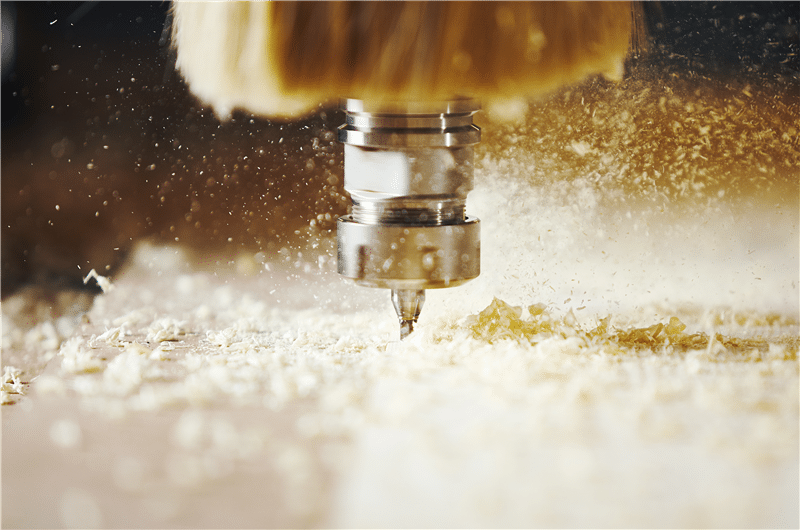
Machining involves the use of machines and tools to cut materials such as metal, plastic, or wood. This technique is a subtractive process, meaning that machining shapes parts by removing successive layers of material. The goal is to give the part a very specific shape. The cut parts are then used to manufacture objects or assemblies of all sizes, ranging from accessories to furniture, architectural components, and interior design modules.
In terms of application, wood machining requires adjusting the cutting speed based on the type of wood product or even the species of wood being machined, although the process is generally fast. The goal is to achieve a clean cut and prevent the wood from burning. For example, machining a softwood such as fir will require a rotational speed of over 18,000 revolutions per minute, depending on the diameter of the tool used.
The Benefits of Using Wood Cutters
Milling cutters designed for woodworking offer enhanced precision, enabling clean and consistent cuts. They deliver superior cut quality, ideal for decorative or functional profiles. Thanks to their design, they provide reliable repeatability, ensuring consistent results from one piece to the next. Using these cutters also increases production efficiency by reducing machining times and labor requirements. In short, they are essential for producing high-quality parts while improving workshop productivity.
All of these advantages, when combined, make wood machining a particularly reliable technique compared to traditional methods. The latter do, in fact, have certain limitations, particularly in terms of time constraints, efficiency, and complexity. The goal here is to optimize the manufacturing process to make the work of artisans and manufacturers easier.
The TopSolid Suite of CAD, CAM, PDM, and ERP Solutions





When CAD/CAM Software Transforms Woodworking
Support for Wood Machining in CAD/CAM Software
Woodworking is getting a boost from CAD/CAM software, which allows users to create detailed and realistic 3D models. These tools also make it possible to integrate design and manufacturing by supporting various key steps:
- visualizing the final piece before starting the work;
- correcting design errors before manufacturing begins;
- taking into account the various factors related to the means of production;
- calculation and optimization of flow rates to better estimate the associated costs.
Planning ahead is essential to ensure the effectiveness and accuracy of your projects!
The Benefits of CAD/CAM Software for Woodworking
From a practical standpoint, CAD/CAM software also offers a number of advantages for manufacturing parts and objects with confidence. It automates the generation of toolpaths, incorporates simulation to avoid collisions or unmachined areas, and optimizes cutting parameters (speed, feed rates, depth). This level of preparation ensures production that closely matches the model, with excellent surface quality and a smoother process. These benefits extend to all phases of manufacturing.
A high degree of design freedom
The use of CAD/CAM software opens up a wide range of possibilities right from the design phase. Simply put: anything is possible and can be visualized down to the smallest detail. This flexibility also allows for highly precise adjustments to optimize production as much as possible. Whether it’s engraving, 2D cutting, or 3D and even 5-axis machining, CAD/CAM makes it possible to create sophisticated shapes that are difficult to produce manually in a short amount of time.
Increased efficiency and productivity
On the other hand, although there are many creative possibilities, the software is so user-friendly that the design process becomes quick and efficient. This stage of the creative process can therefore be handled in-house, saving both time and money.
Work done with millimeter precision
Using CAD/CAM software also means anticipating absolutely every parameter before production begins. As a result, the risk of error is significantly reduced, while the precision and repeatability of manufacturing operations are enhanced.
The case study from Entrawood, a South African office furniture specialist, illustrates the benefits of an integrated wood CAD/CAM system: a 65% reduction in defects and large-scale customized production. Explore this case study and see for yourself.
How can you integrate CAD/CAM software with your woodworking machines?
TopSolid’Wood is a one-of-a-kind software solution on the market. Its parametric, integrated CAD/CAM system meets the specific needs of woodworking.
Specially designed for craftspeople, the tool takes all your machining challenges into account, starting right from the modeling phase. It offers powerful, customizable features that adapt to your unique expertise while building on your daily work.
Would you like to learn more about TopSolid’Wood? Contact us!